

You may know the vocabulary, understand the grammar, and follow most conversations in English—until someone with a different accent starts speaking. Suddenly, everything feels confusing. Words blur together, familiar phrases sound unfamiliar, and your confidence drops. This is a common experience for language learners around the world.
Why Accents Can Be Difficult to Understand
Accents are a natural part of language. Every speaker brings their own rhythm, pronunciation habits, and speech patterns based on their region, culture, and first language.
Even native speakers sometimes struggle with unfamiliar accents. This happens because:
Different vowel sounds: The same word can sound very different depending on the accent.
Unique rhythm and stress: Some accents are faster, slower, or place stress on different syllables.
Dropped or blended sounds: Certain consonants may disappear or merge into others.
Local expressions and intonation: Tone and phrasing can vary widely.
Your brain learns to recognize patterns. When the pattern changes, comprehension drops—at least at first.
Where the Real Problem Appears
Many learners only practice with one “standard” accent, usually from textbooks or a single teacher. As a result:
They can understand slow, clear speech.
They struggle with natural, fast conversations.
They feel lost in international environments.
This becomes a serious issue in real-life situations such as:
International workplaces
Travel and immigration
Online meetings
Customer service calls
The gap between classroom English and real-world English is often caused by accent differences.
How to Understand Different Accents: A Step-by-Step Guide
Step 1: Listen to a Variety of Voices 🎧
Expose yourself to speakers from different regions—British, American, Australian, Indian, and more. The more variety you hear, the faster your brain adapts.
Step 2: Focus on Sounds, Not Spelling 🔤
English spelling is not always reliable. Train your ears to recognize sounds instead of depending on how words look on the page.
Step 3: Use Short, Repeated Listening 🔁
Listen to short audio clips several times. First for the general meaning, then for specific words and pronunciation.
Step 4: Shadow Native Speech 🗣️
Repeat what you hear immediately after the speaker. This builds familiarity with rhythm, stress, and connected speech.
Step 5: Practice with Realistic Listening Content 🤖
Tools like ListenLeap transform English podcasts and videos into effective learning materials tailored to your interests and proficiency level. By recommending diverse podcast voices and integrating AI-powered support, ListenLeap helps you regularly train your ears with authentic accents while strengthening overall comprehension.
Quick Comparison: Accent Challenges and Solutions
Tips, Advice, and Common Mistakes
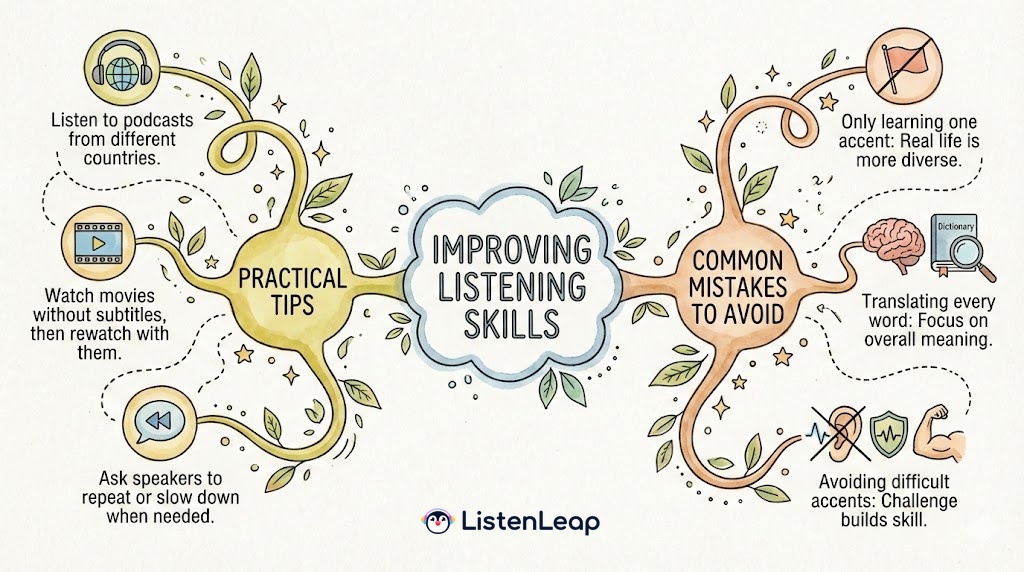
Practical Tips
Listen to podcasts from different countries.
Watch movies without subtitles, then rewatch with them.
Ask speakers to repeat or slow down when needed.
Common Mistakes to Avoid
Only learning one accent: Real life is more diverse.
Translating every word: Focus on overall meaning.
Avoiding difficult accents: Challenge builds skill.
FAQ
Is it normal to struggle with different accents? Yes. Even native speakers sometimes need time to adjust to unfamiliar accents.
How long does it take to get used to a new accent? With regular exposure, many learners notice improvement within a few weeks.
Should I learn one accent or many? Start with one for clarity, but gradually expose yourself to multiple accents.
What’s the best way to practice accent comprehension daily? Short, consistent listening sessions—especially using adaptive podcast tools that match content to your level and interests—are highly effective.
Key Takeaways
Accent differences are normal and unavoidable.
Limited exposure is the main reason comprehension drops.
Regular, varied listening builds real-world understanding.
Structured, interest-based listening practice speeds up adaptation.
If you want to become comfortable with real-world conversations, start training your ears with diverse podcast voices and AI-supported listening practice. Search ListenLeap on the App Store or Google Play, download it, and begin building real-world listening confidence today.



Comments
No comments yet.
Leave a Comment