

Reading Is Not Listening — and Nobody Told You
A learner can breeze through an English news article, recognize nearly every word, then press play on a podcast and catch maybe half of what the host says. This gap shows up in forums and classrooms constantly, and it is rarely a vocabulary problem. The words are known. The grammar is known. What is missing is a separate skill: turning sound into meaning in real time.
Reading and listening look like two doors into the same room, but the brain treats them as different routes. Reading starts with a visual symbol and moves to meaning. Listening starts with a stream of sound, segments it into words, and only then reaches meaning. A strong reader can have an untrained ear, because the visual route was practiced for years while the sound route was never built. That is the whole explanation — and the good news is that the sound route can be trained on its own.
Three Things Reading Never Taught Your Ears
1. Words are stored as spelling, not as sound
Most learners memorize vocabulary in its written form. The brain files the word as a picture: t-h-o-u-g-h. But spoken English rarely matches its spelling, and "though," "thought," and "through" sound nothing like they look. A learner who has only met a word in print often does not recognize its spoken form at all — the word is "known," but the ear has no file for it.
2. Real speech does not respect word boundaries
In connected speech, words blur into each other. "Want to" becomes "wanna," "did you" becomes "didja," "give me" becomes "gimme." Speakers also link and reduce constantly: "turn off" runs together, "could have" collapses to "coulda." Text shows clean spaces between words; audio shows none. Reading never prepares the ear for this.
3. Speech gives no pause button
A reader can stop, re-read, and look things up. A listener gets one chance — the sentence keeps moving. The cognitive load of segmenting a fast stream of sound is the real bottleneck, and it only improves with targeted practice, not with more reading.
Rebuild Listening as a Skill of Its Own
The fix is not "listen more." It is listening in a way that forces the ear to do the segmentation work. The five steps below are built around that idea.
Step 1: Pick audio where you already catch most sentences
Training works when the material sits just above comfort level. A podcast where nothing is understood teaches nothing; one where everything is understood adds nothing. ListenLeap's placement test sorts its 10,000+ podcasts by difficulty, so a learner can land in the band where most sentences are catchable and a few are not — the zone where the ear actually improves.
Step 2: Listen blind before you read anything
Hit play without looking at the transcript. Write down or mentally note the spots where the sound fell apart. Then, and only then, open the subtitles. In ListenLeap, this means using blind-listening mode first, then switching on the bilingual subtitles to check. The contrast between what was heard and what was actually said is the most instructive moment in the whole exercise — it shows exactly which words the ear failed to file.
Step 3: Sort every miss into one of two buckets
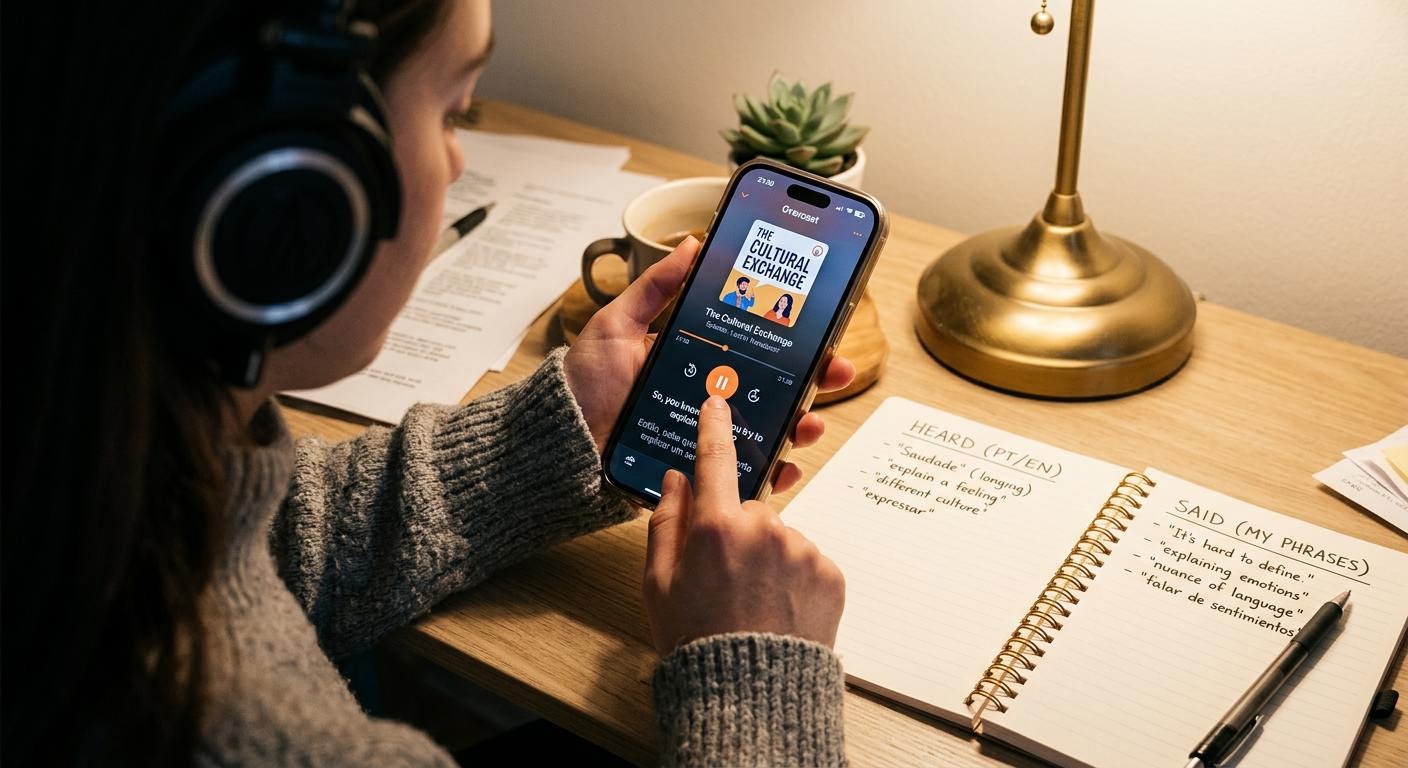
When a phrase fails, the question is simple: was the word unknown, or known but unheard? Most misses are the second type. Tapping the phrase in ListenLeap brings up the word meaning and a full-sentence breakdown, which makes the bucket obvious in seconds. Known-but-unheard words go into a listening notebook — these are the real targets. Unknown words go into the vocabulary list and are handled separately.
Step 4: Use fill-in-the-blank to force the ear
This is the single most efficient drill for the gap. When a sentence plays with one word blanked out, the brain has to segment the sound stream and pull the missing word from context — exactly the skill that reading never trained. ListenLeap's fill-in-the-blank training mode runs this exercise on real podcast audio, which beats generic textbook sentences because the speaker is a real person at real speed.
Step 5: Shadow short segments to close the loop
Take a 20- to 30-second clip the learner can now fully hear, and repeat it aloud with the speaker, matching rhythm and intonation. This forces the mouth to reproduce what the ear just decoded, locking in the sound-to-meaning connection. ListenLeap's shadowing mode scores pronunciation, intonation, and fluency separately, so a learner can see whether the problem is hearing the sound or producing it — two different failures that need two different fixes.
A Two-Week Plan to Close the Gap
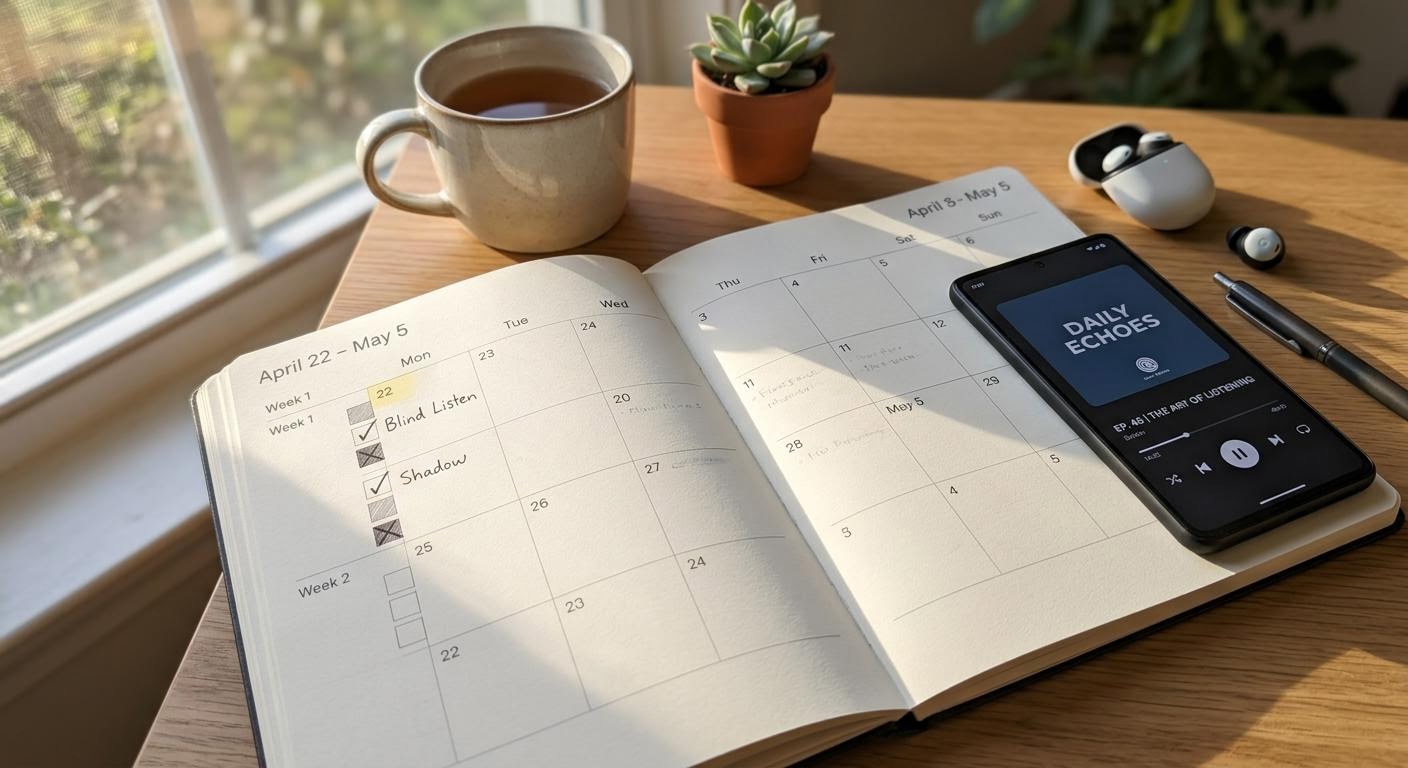
Week 1 — map the gap. Days 1-3: fifteen minutes of blind listening plus a transcript check per day, sorting every miss into the two buckets. Days 4-7: keep the same routine, and start collecting the known-but-unheard words into the notebook with the phrase they appeared in.
Week 2 — train the ear directly. Days 8-11: replace half the blind-listening time with fill-in-the-blank drills on the same episodes. Days 12-14: add ten minutes of shadowing on the clips that were fully understood.
Twenty minutes a day is enough. The point is not volume — it is that every minute forces the ear to do segmentation work instead of letting the eyes do it.
The Goal Is a Trained Ear, Not More Hours
Reading skill will not transfer to listening by accident. The ear needs its own practice, its own feedback, and its own record of misses. Once the training targets the right bottleneck — segmentation under real-time pressure — progress becomes visible within weeks, not years. The words were always there. The ear just needs the file.




Comments
No comments yet.
Leave a Comment