

If you’ve ever said “I bought book” or “She is the best teacher in school” and felt unsure, you’re not alone. Small words like a, an, and the cause big problems for English learners. They look simple, but they carry important meaning about whether something is general, specific, or already known.
Using articles incorrectly can make sentences sound unnatural, even when the rest of the grammar is perfect. Mastering them is one of the fastest ways to sound more fluent.
What English articles actually do
Articles tell the listener whether you’re talking about something general or specific.
I saw a dog. → Any dog.
I saw the dog. → A specific dog we both know.
Where most learners go wrong
Here are the most common situations where articles are misused:
1. Leaving articles out completely
Many languages don’t use articles, so learners drop them.
❌ She bought car yesterday.
✅ She bought a car yesterday.
2. Using “the” for everything
Some learners overuse the because it feels safer.
❌ I like the music.
✅ I like music. (music in general)
3. Confusion with professions and roles
❌ He is teacher.
✅ He is a teacher.
4. Problems with general vs. specific meaning
I need a pen. → Any pen.
I need the pen. → A specific pen.
How to use English articles correctly: a step-by-step guide
🧭 Step 1: Ask if the noun is general or specific
General idea → use a/an or no article.
Specific item → use the.
Example
I want a coffee. (any coffee)
I want the coffee on the table. (specific one)
🔁 Step 2: Check if it’s the first or second mention
First time → a/an
Second time → the
Example
I saw a cat.
The cat was sleeping.
👂 Step 3: Listen to the sound, not the spelling
Use an before vowel sounds, not just vowel letters.
an hour (silent h)
a university (starts with “you” sound)
🧠 Step 4: Remember special cases
No article is needed with:
Plural general nouns: Dogs are friendly.
Uncountable nouns: Water is important.
Languages and subjects: She studies English.
🗣️ Step 5: Practice in real conversation
Practice in real conversation regularly. Reading grammar rules isn’t enough; you must actively speak and listen in authentic interactions. Engaging with native speakers or AI tutors builds fluency, confidence, pronunciation accuracy, and natural sentence formation.
Quick reference chart
Practical tips and common mistakes
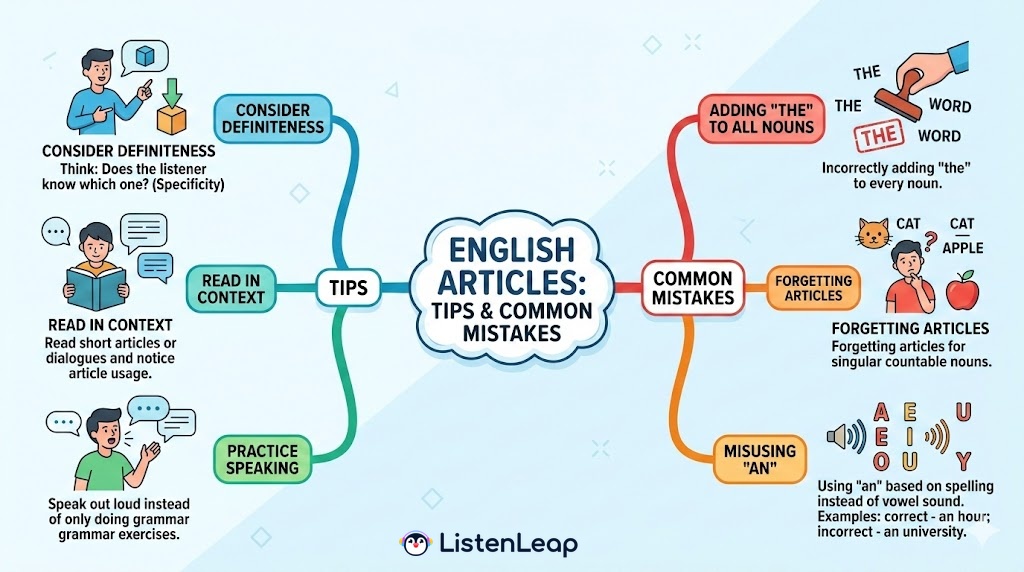
Tips
Think: Does the listener know which one I mean?
Read short articles or dialogues and notice article usage.
Speak out loud instead of only doing grammar exercises.
Common mistakes
Adding the to all nouns.
Forgetting articles before singular countable nouns.
Using an based on spelling instead of sound.
A practical way to fix these habits is through repeated exposure and active listening. Tools like ListenLeap recommend podcast content based on your interests and level, then use AI assistance to help you notice grammar patterns — including article usage — in real context. Over time, this repeated input helps correct habits naturally.
FAQ
Why does English need articles when my language doesn’t?
Articles give extra information about whether something is specific, new, or general. English relies on them to avoid confusion.
Can I skip articles and still be understood?
Often yes, but your speech may sound unnatural or unclear in certain situations.
How long does it take to master articles?
With regular practice and consistent exposure, most learners see noticeable improvement in a few weeks.
Key takeaways
Articles show whether something is general or specific.
Most mistakes come from omission or overusing the.
Think about first mention vs. known information.
Real-world input and active practice make article use automatic.
If you want to fix article mistakes faster, focus on consistent exposure instead of only reading rules. Search ListenLeap on the App Store or Google Play, explore podcast content that matches your interests, and start learning English in a more natural, engaging way.



Comments
No comments yet.
Leave a Comment