

You Learned English, Then a British Podcast Made You Feel Like a Beginner
There's a specific kind of frustration that hits when an English learner — someone who can follow American podcasts, pass reading tests, hold conversations — presses play on a BBC documentary or an Australian interview and catches maybe 40% of what's being said.
It's not a vocabulary problem. It's not grammar. The words are the same. But the sounds are different enough that the brain keeps tripping over them. The "r" that disappears in British English. The vowels that shift in Australian speech. The rhythm changes in South African or Irish speakers.
Most English courses teach one accent — usually General American or standard British RP — and treat everything else as an afterthought. That's a gap in training, not a gap in ability. And it's fixable with the right kind of listening practice.

Why Accents Feel So Much Harder Than They Should
English has more accent variation than most learners expect. A speaker from London, a speaker from Texas, and a speaker from Melbourne are all speaking the same language — but they handle vowels, consonants, stress, and rhythm differently enough to trip up anyone trained on just one variety.
Three things make unfamiliar accents hard:
Vowel shifts.The word "dance" has a short "a" in American English but a long "ah" in most British accents. "Day" in Australian English can sound closer to "die" to an untrained ear. These shifts aren't random — they follow patterns — but without exposure, each one becomes a small processing delay.Consonant differences.The most famous example: rhoticity. American speakers pronounce the "r" in "car" and "water." Most British and Australian speakers don't. That missing "r" changes the shape of entire sentences for someone who learned with American audio.Rhythm and intonation.Australian English tends to rise at the end of statements, making everything sound like a question. British English often compresses unstressed syllables more aggressively than American English. These rhythm differences change how the brain segments speech into words.
None of these differences are obstacles once the ear has been calibrated. The problem is only that most learners never get systematic exposure to more than one accent.
Trick 1: One Accent, One Week, Full Immersion
Trying to "get used to all accents" at once doesn't work. The ear needs focused input to pick up a new set of sound patterns.
Pick one accent — British, Australian, Irish, South African, Scottish, whatever feels hardest right now — and listen exclusively to speakers with that accent for five to seven days. Not all day, but every listening session that week should feature that accent.
This means choosing podcast episodes hosted by speakers from that region. On ListenLeap, filtering by topic area and previewing episode hosts makes it straightforward to find content in the target accent — BBC-sourced episodes for British English, for example, or TED talks from Australian presenters. The i+1 difficulty grading also helps ensure the episodes are challenging for the accent, not for the vocabulary.
By day three or four, the "fog" starts lifting. The vowel shifts become predictable. The missing consonants stop causing confusion. By day seven, that accent no longer feels foreign — it just feels like a different flavor of English.

Trick 2: Use Subtitles as a Bridge, Then Take Them Away
When facing an unfamiliar accent, subtitles act as a translation layer between what the ear hears and what the brain expects. The first two or three listens of a new accent should use text support. After that, subtitles need to go.
Here's the progression:
Listen 1: Full subtitles on.Read along while listening. The goal is to connect the unfamiliar sounds to known words. When the Australian speaker says something that sounds like "naow" and the text reads "no," the brain files that mapping.Listen 2: Subtitles on, but eyes closed for stretches.Try to follow by ear. Open eyes only when something goes blurry. This builds a halfway bridge — the text is available, but the ear is doing most of the work.Listen 3: Subtitles off completely.This is the real test. Play the same segment without any text. The phrases that were practiced with subtitles should now be recognizable by sound alone.
ListenLeap's blind listening mode is built for exactly this sequence — it hides all subtitles until the learner taps to reveal them, which prevents the eyes from doing the ear's job. For the first two passes, the bilingual subtitle view keeps both the English text and a native-language translation on screen, which speeds up the mapping process without requiring a dictionary detour.
Trick 3: Shadow the Sounds That Don't Exist in Your Default Accent
Shadowing — repeating what a speaker says immediately after hearing it — is effective for any listening skill, but it's especially powerful for accent training. The mouth helps the ear.
When a learner shadows a British speaker saying "water" without the "r" ("woh-tuh"), the motor memory of producing that sound reinforces the auditory recognition of it. The next time that sound appears in a different sentence, the brain catches it faster because it already knows how it feels to say it.
The key is to shadow the accent, not correct it. If the speaker drops an "r," drop it. If the vowel sounds different, copy that vowel. Don't translate back into a familiar accent — the whole point is to build a new sound library.
ListenLeap's shadowing feature scores three dimensions — pronunciation, intonation, and fluency — which gives specific feedback on whether the accent mimicry is landing. A low intonation score, for instance, often means the stress pattern hasn't been copied accurately, which is one of the hardest parts of accent matching.
Trick 4: Run Fill-in-the-Blank Drills on Accent-Heavy Segments
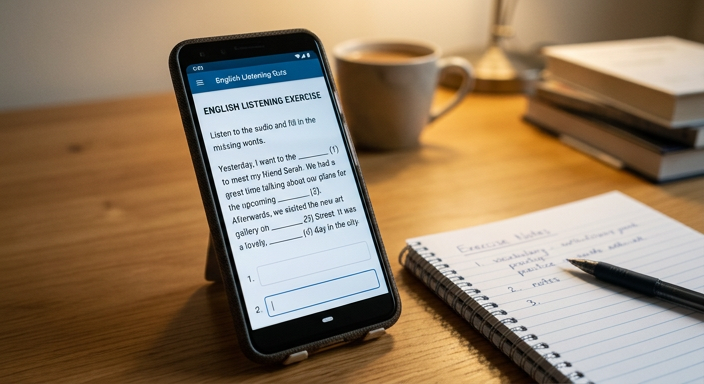
Passive re-listening helps, but active recall drills lock in the patterns faster. Fill-in-the-blank exercises force the brain to produce the exact word from an accented sound, which is a much harder — and more useful — task than simply recognizing it.
Pick a segment where the accent caused the most confusion. Listen to it, then try to fill in the missing words from memory. The blanks naturally fall on the words that the accent distorted most — exactly the ones that need the most training.
ListenLeap's fill-in-the-blank training mode automates this process: it removes words from the transcript and plays the audio, requiring the learner to type in what they hear. For accent training, this is gold, because the blanks tend to fall on reduced or accent-shifted words — the very sounds that need the most ear-time.
Trick 5: Compare the Same Story Across Different Accents
News stories are perfect for this. When a major event happens, BBC, NPR, ABC Australia, and CBC Canada all cover it — same facts, same key vocabulary, different accents.
Find the same story across two or three of these sources and listen to each version. The content is familiar because the facts don't change, so all the brain's processing power goes toward handling the accent differences. Notice how the same word — "process," "schedule," "controversy" — gets pronounced differently. Notice how sentence rhythm shifts between an American and a British newsreader.
This comparison drill builds flexible listening. Instead of being locked into one accent's sound system, the brain learns to treat accent variation as normal background noise rather than a processing error.
Doing this once or twice a week with 5-to-10-minute news segments is enough. ListenLeap carries episodes from BBC, NPR, and other major sources, so finding overlapping coverage on the same topic usually takes less than a minute of browsing.
Accent Comfort Is Closer Than It Feels
Most learners overestimate how long accent adaptation takes. With focused daily practice — even just 10 to 15 minutes — a new accent typically shifts from "barely comprehensible" to "mostly clear" within two to three weeks. The brain is remarkably fast at recalibrating once it gets consistent, focused input.
The mistake is waiting for accent comfort to happen on its own. It won't. Occasional exposure to a British podcast here or an Australian interview there spreads the input too thin for the brain to extract patterns. The five tricks above work because they concentrate the exposure: one accent at a time, subtitles as scaffolding, active production through shadowing and drills, and cross-accent comparison to build flexibility.
Pick the accent that frustrates you most. Find a podcast in that accent. Start this week. Three weeks from now, the same speakers who sounded impossible will just sound like people talking.




Comments
No comments yet.
Leave a Comment