

Many language learners hit a confusing point: you understand the basics, you can hold simple conversations, but then a new question appears—which accent should you focus on? American, British, Australian, or something else? The choice can feel overwhelming, especially when every teacher, video, or podcast sounds slightly different.
The truth is, accent choice matters less than most learners think. What matters more is clarity, confidence, and consistent practice.
Why Accent Choice Feels So Confusing
English is spoken across dozens of countries, and each region has its own pronunciation patterns, rhythm, and vocabulary. Learners often worry that choosing the “wrong” accent will make them sound unnatural or difficult to understand.
Common concerns include:
“Will people understand me if I mix accents?”
“Do I need to pick one accent and stick to it?”
“Is one accent more correct or more professional?”
These worries are normal—but they’re usually based on myths rather than real communication needs.
Where the Real Problem Starts
The confusion usually comes from three sources:
Too many inputs
You watch American shows, follow a British teacher on YouTube, and listen to Australian podcasts. Your pronunciation becomes inconsistent.
Fear of sounding wrong
Some learners delay speaking practice because they’re unsure which accent to copy.
Unclear learning goals
Without a clear reason for choosing an accent, every option feels equally important.
In reality, accent choice should be based on practical use, not perfection.
How to Choose an Accent: A Simple Step-by-Step Guide
🧭 Step 1: Identify Your Main Use Case
Ask yourself:
Will you work or study in a specific country?
Do most of your colleagues or clients come from one region?
Are you preparing for a specific exam?
🎧 Step 2: Choose One Main Reference Voice
Pick a consistent source:
A podcast host
A teacher
A language app voice
A news presenter
This helps your brain build stable pronunciation habits.
If you’re learning through podcasts, using a structured platform like ListenLeap can make this process easier. Since ListenLeap recommends podcast content based on your interests and proficiency level, you can intentionally stick to speakers from one region and build consistent listening exposure.
🗣️ Step 3: Focus on Clarity, Not Perfection
Instead of copying every detail of an accent:
Practice clear vowel sounds
Slow down your speech
Use natural sentence rhythm
Most global English conversations involve people with different accents. Clarity matters more than imitation.
🤖 Step 4: Practice with Adaptive Learning Tools
Consistent listening and active engagement are what ultimately stabilize your pronunciation. When you regularly hear one accent and interact with the content, your speech patterns gradually align in a natural way. With adaptive learning tools, you can:
Learn from real English podcasts and videos
Follow content matched to your level and interests
Use AI-powered assistance to understand vocabulary and expressions
Build sustainable listening habits that support clearer speaking
Practical Tips and Common Mistakes
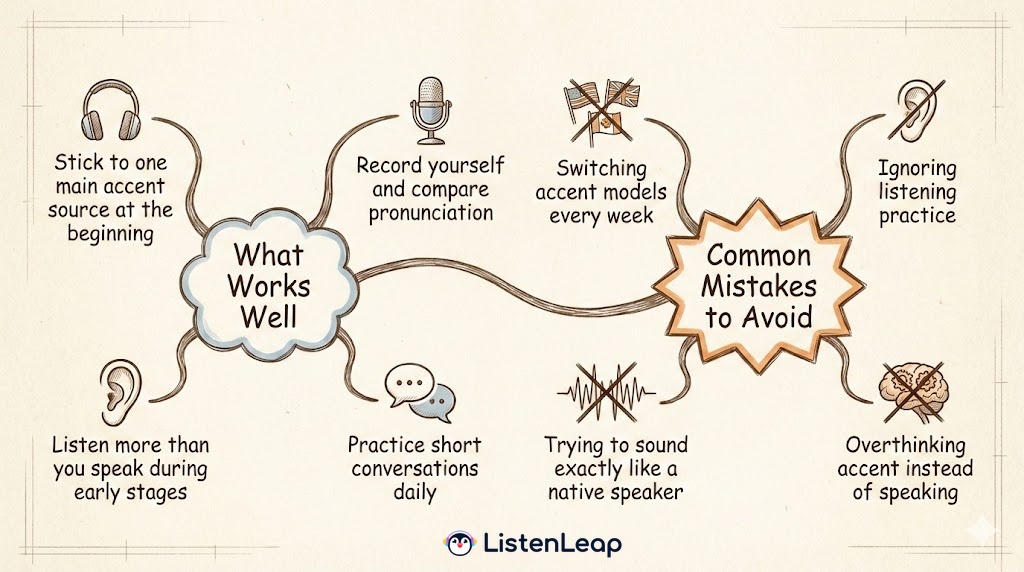
What Works Well
Stick to one main accent source at the beginning
Listen more than you speak during early stages
Record yourself and compare pronunciation
Practice short conversations daily
Common Mistakes to Avoid
Switching accent models every week
Trying to sound exactly like a native speaker
Ignoring listening practice
Overthinking accent instead of speaking
Quick Comparison: Accent Choice at a Glance
FAQ
Do I have to choose only one accent? No. Many fluent speakers naturally use a mixed accent. The key is being clear and consistent.
Which accent is easiest to learn? For many learners, standard American or standard British accents are easiest because of the large amount of learning material available.
Will people judge my accent? In most international environments, people care more about clarity and confidence than accent type.
The Key Takeaways
Accent choice should match your real-life goals.
Clarity is more important than sounding native.
Consistent listening leads to consistent speaking.
Daily practice is the fastest way to improve.
Pick your target accent, practice with structured daily listening in ListenLeap, and steadily improve your clarity, rhythm, and pronunciation — available now on the App Store and Google Play.



Comments
No comments yet.
Leave a Comment