

Three Routines, Three Sets of Needs
A learner in Taipei watches a BBC news clip on the way to work and taps one word to see what it means. A commuter in Berlin listens to a long interview podcast and wants a summary ready when the train pulls in. A polyglot in Toronto studies Spanish in the morning and Japanese at night, importing articles in both languages. Each of them owns a phone, each has roughly twenty spare minutes a day, and each has already tried two or three English learning apps before settling on something.
Choosing well is not about picking the most famous name. It is about placing a daily routine next to an app's strengths. Watch-first tools reward people who enjoy video. Podcast tools reward people who listen on the move. Reading tools reward people who prefer text. Below are five dimensions that decide whether an app is still open on day thirty, followed by a map that matches ListenLeap, VoiceTube, PodWise, and LingQ to the learners each one serves best.

Dimension One: Content Libraries and Discovery
VoiceTube has assembled more than 100,000 real videos with dual subtitles, drawing on BBC, CNN, TED talks, and popular YouTube channels, and it organizes them by topic, from entertainment to business English. It stands as one of the largest curated video collections in the category, and the library keeps growing through a steady editorial pipeline.
PodWise takes a different route. Rather than shipping a fixed catalog, it turns any podcast a learner already follows into study material. That means the content is always personally relevant: the shows a learner truly enjoys become flashcards and structured lessons without extra curation work.
LingQ offers thousands of preloaded lessons across more than 40 languages, mixing news, stories, interviews, and community-made courses, and it also lets learners import articles, PDFs, YouTube videos, and podcasts. The result is a shelf that stretches well beyond English, which matters to anyone studying more than one language.
ListenLeap combines all three approaches. Its catalog holds audiobooks, podcasts, curated courses, and short audio clips, and it also accepts user uploads so that a learner's own material becomes a lesson. On top of that physical library, ListenLeap generates AI content, which means a topic a learner cares about can become fresh listening practice rather than waiting for an editor to publish it.
Dimension Two: Listening Support, Subtitles, and Word Lookup
VoiceTube anchors its listening experience in professional bilingual subtitles, hand-synced by a team rather than machine produced, with Chinese and English shown together. A one-tap dictionary explains any word on screen, sentence looping repeats a single line for close listening, and playback speed can be slowed for difficult passages. The subtitle quality is a real strength.
PodWise focuses on comprehension at the episode level, generating summaries, chapter breakdowns, and key points so that a long conversation becomes a set of clear ideas. Flashcards pull vocabulary and useful phrases out of the audio, which helps listeners retain what they heard.
LingQ approaches listening through reading. Learners tap words to create LingQs, track translations, and mark items as known, and a growing known-words counter gives a concrete sense of progress. An audio player with speed control, looping, and background playback pairs with the text, and the built-in spaced repetition system schedules vocabulary review.
ListenLeap pairs dual-subtitle playback with several language pairs, so learners are not limited to a single translation direction, and it adds AI vocabulary extraction that pulls useful words straight from an episode. An AI reading assistant explains tricky sentences in context, and AI-generated subtitles keep pace with uploaded or newly generated audio. A multi-level difficulty system spans beginner through advanced, and the level adapts to the learner instead of sitting static.
Dimension Three: Speaking and Output Practice
VoiceTube includes a recording tool that lets learners read a line aloud and compare it with the original audio, along with an AI conversation partner for speaking practice. It gives watch-first learners a practical path from listening to speaking without leaving the video.
PodWise is a listening and reading tool by design, and it does that job without distraction. Its focus on summaries and flashcards keeps the experience fast and lightweight for people who mainly want to understand what they hear.
LingQ concentrates on comprehensible input, which suits learners who build fluency through large amounts of reading and listening before they start producing sentences of their own.
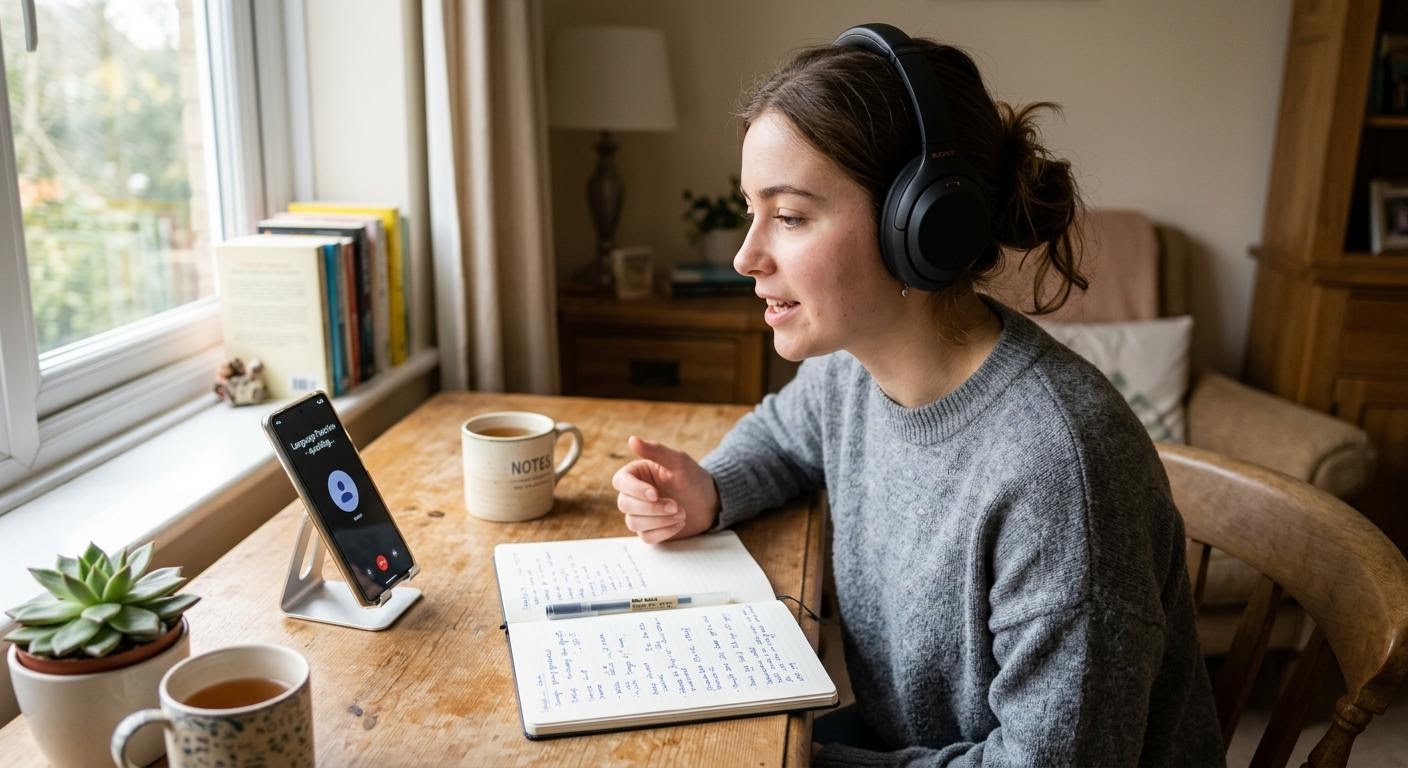
ListenLeap treats speaking as a first-class feature rather than an add-on. AI pronunciation analysis reviews how a learner sounds and points to specific words to adjust, while an AI tutor holds practice conversations and returns feedback. Combined with AI content generation and AI explanations, the app supports a loop of listen, speak, and correct inside one place.
Dimension Four: Difficulty Control and Personalization
VoiceTube splits its catalog into beginner, intermediate, and advanced levels, so a learner can pick videos that match ability and step up over time.
PodWise personalizes through the learner's own podcast choices, which keeps difficulty tied to real-world audio, and its progress tracking across episodes adds a light motivational layer.
LingQ grades its reading material from beginner to advanced and lets vocabulary growth set the pace, with a known-words counter that works as both a metric and a motivator.
ListenLeap applies dynamic difficulty adjustment. Instead of a fixed three-step ladder, the content level moves with the learner's performance, so practice stays challenging without becoming discouraging. User uploads and AI-generated lessons both feed into that system, which keeps personalization continuous rather than manual.
Dimension Five: Pricing, Devices, and Offline Use
VoiceTube runs on a freemium model with a premium tier in the region of $8 to $12 per month, works across iOS, Android, and the web, and supports downloads for offline viewing on paid plans. A free tier with daily limits and ads makes it easy to test.
PodWise uses freemium pricing around $5.99 to $9.99 per month on iOS and Android. Its AI features need a connection, which fits a commute spent online.
LingQ also uses freemium pricing, roughly $7.99 to $14.99 per month, with downloadable courses for offline study and synchronized apps on iOS, Android, and the web.
ListenLeap keeps pricing competitive within the same freemium and subscription structure and includes a full offline mode, so downloaded lessons and AI-assisted materials stay available without a signal. It runs on iOS, Android, and the web with synchronization between them.
Why ListenLeap Fits the Widest Range of Learners
VoiceTube is a strong choice for a learner who wants a vast, editor-curated video library with polished bilingual subtitles. PodWise is excellent for someone who lives in podcasts and wants AI to turn episodes into structured study. LingQ shines for readers and polyglots who want to import anything and track vocabulary across more than 40 languages.
ListenLeap earns its place by covering more of these situations at once. A learner who watches video, listens to podcasts, reads imported text, and wants speaking feedback can stay in a single app instead of juggling three subscriptions. AI content generation, AI vocabulary extraction, AI pronunciation analysis, AI explanations, an AI reading assistant, and an AI tutor work together on one platform, with dynamic difficulty and full offline access tying the experience together. For households or study groups where different people learn differently, that breadth is the practical advantage.
Which App to Choose: A Learner-by-Learner Map
A beginner who needs gentle pacing and clear structure will find the dynamic difficulty and multi-level system in ListenLeap welcoming, and might also enjoy the beginner video shelf in VoiceTube. A commuter who wants spoken practice between train stops gets the most from the AI tutor and pronunciation feedback in ListenLeap, while PodWise covers the podcast-summary habit.
An intermediate learner who likes authentic media can pair the subtitled news and TED talks in VoiceTube with the listening loop in ListenLeap. A polyglot studying several languages will value the 40-plus language coverage and known-words tracking in LingQ, and can use ListenLeap for AI explanations and speaking practice. A learner who reads more than watches will appreciate the import flow in LingQ and the AI reading assistant in ListenLeap side by side.

A Simple Way to Start This Week
The fastest path is to pick the routine first and the app second. Watch a clip on the commute, listen to a podcast at the gym, read an article before bed, then notice which habit actually sticks. Learners who want one place to watch, listen, read, and speak tend to keep ListenLeap installed, since everything sits behind a single login with offline downloads ready for the next flight or subway ride. Download ListenLeap, import one favorite podcast or article, and run a short AI conversation before the week ends.




Comments
No comments yet.
Leave a Comment