

Most people who have studied English for years know the same frustrating moment. A podcast host laughs at a joke, the group on screen reacts, and the meaning arrives three seconds too late. Reading feels comfortable, grammar drills feel familiar, and still the fastest conversations slide past. The problem is rarely effort. Many learners already listen every day, during a commute, at the gym, or while cooking dinner. What separates steady progress from endless replay is the tool that turns ordinary listening into focused practice. In 2026, four apps keep appearing in conversations about this exact challenge: ListenLeap, PodWise, RedKiwi, and EWA. They share one goal, and they reach it through very different methods. This overview looks at how each one supports real listening growth.

Why Listening Is the Hardest Skill to Train Alone
Listening is the one skill that gives a learner no time to think. A reader can pause, reread, and look up a word. A listener has to decode rhythm, linked sounds, reductions, and unfamiliar accents in a single pass. That is why passive hours rarely translate into skill. Progress comes from short, deliberate sessions with clear feedback.
Each of the four apps solves this in its own way. PodWise attacks the problem with automation, turning any podcast into summaries, flashcards, and key points. RedKiwi leans on short video clips and game-like drills that keep attention high. EWA builds a wide, multimodal library where films, books, and grammar lessons sit side by side. ListenLeap combines a broad audio library with a structured difficulty path and dedicated speaking tools. None of these approaches is wasted. The right match depends on how a learner prefers to practice.
Content Libraries and Real-World Audio
The quality of the source material shapes everything that follows, and here the four apps differ sharply in scope.
PodWise offers a distinctive strength: it works with the podcasts a learner already loves. Any episode can become a study session, with AI summaries and extracted highlights. The app sidesteps content curation entirely, so the material always feels personally relevant and never runs dry as long as new episodes appear.
RedKiwi builds its library from short YouTube clips, drawing on news, vlogs, talks, and entertainment. The collection runs past ten thousand segments and refreshes daily, which keeps the material current and culturally alive. Learners who enjoy short, punchy, real-world content find plenty to work with.
EWA takes the widest approach of the group. Its library spans movie and television clips, a graded reading shelf with more than a thousand books, flashcard decks, grammar courses, and audio lessons. This breadth lets a learner switch between formats whenever attention dips, and the movie clips give EWA a strong sense of entertainment.
ListenLeap gathers audiobooks, podcasts, curated courses, and short audio inside one library, then organizes all of it with a multi-level difficulty system that runs from beginner to advanced. That organization matters. Instead of hunting for suitable material, a learner can move upward through levels and always know the next step is reachable. Bilingual subtitle pairs across many language combinations extend the same material to speakers of different first languages.
Subtitles, Transcripts, and Vocabulary Capture
Subtitles decide whether a difficult passage becomes a lesson or a blur, and every app here handles them thoughtfully.
RedKiwi shows dual subtitles in more than ten languages, pairing English with a learner's native language. Each clip carries fill-in-the-blank listening tasks, multiple-choice comprehension questions, and a dictation mode that checks answers instantly. A spaced-repetition vocabulary book stores saved words and schedules them for review.
EWA brings subtitles to its film clips and supports them with a flashcard system that holds over fifty thousand cards, complete with pictures and example sentences. Its graded readers also include audio narration, so a learner can read and listen at the same time.
PodWise generates transcripts automatically and then layers intelligence on top, producing summaries, chapter breakdowns, flashcards for vocabulary and key phrases, and clean extracts of the main points. For anyone who wants to grasp an episode quickly, this automation is genuinely useful.
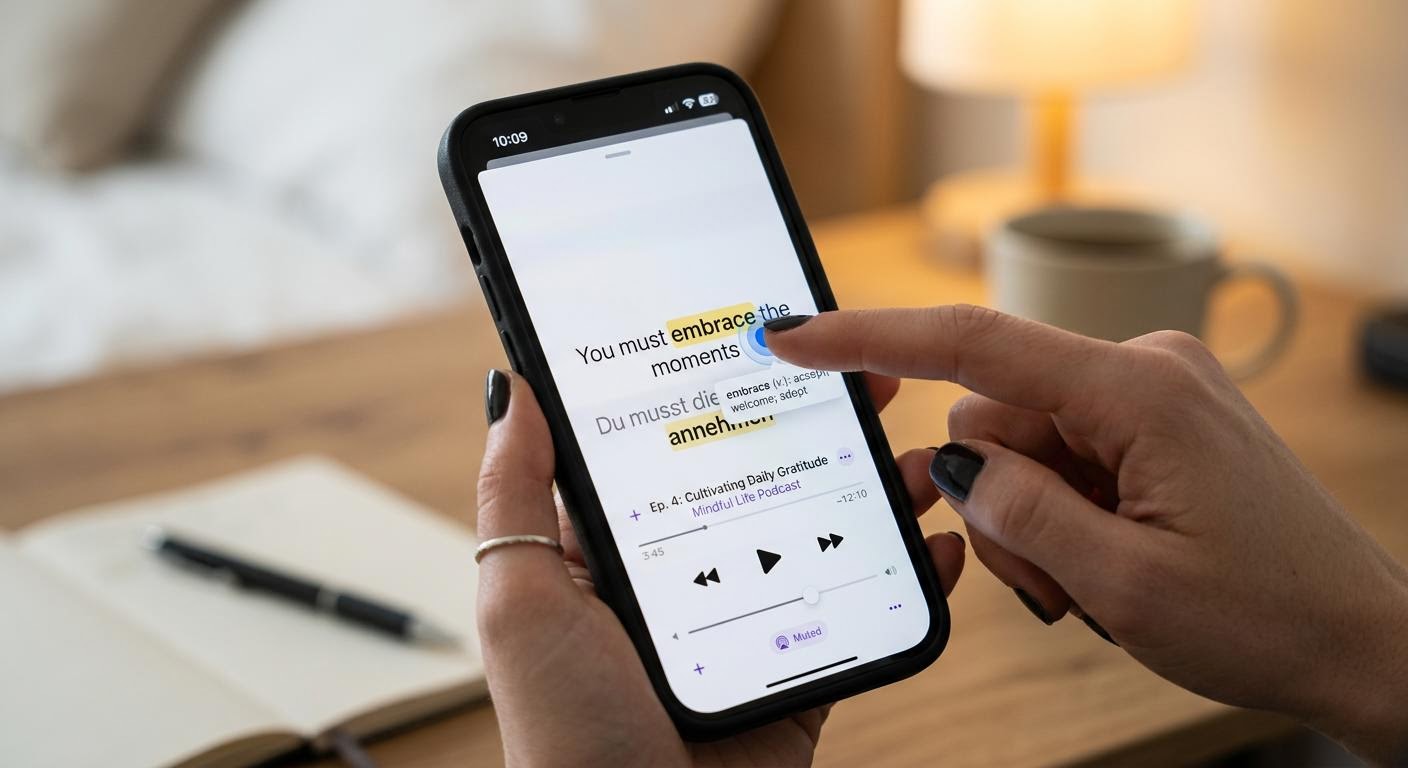
ListenLeap pairs audio with bilingual dual subtitles and adds AI vocabulary extraction, so unfamiliar words are pulled from the exact moment they appeared and collected into a review list. Because the subtitles are aligned line by line, a learner can replay a single sentence, confirm the meaning, and continue without losing the thread. This combination of graded content, aligned bilingual text, and automatic word capture keeps the loop between listening and vocabulary tight.
Speaking Practice and Pronunciation Feedback
Understanding speech is only half the loop. Producing it is the other half, and the four apps handle output very differently.
RedKiwi includes a shadowing mode that lets learners imitate a line right after hearing it. The feature fits naturally into the clip flow and gives shy speakers a low-pressure way to build confidence out loud.
EWA offers dubbing, where a learner speaks along with a movie scene and receives a score, plus an AI chatbot for simulated conversation. Both features make speaking feel playful, and the chatbot gives learners a partner whenever a real one is unavailable.
PodWise focuses squarely on input. Its strength is comprehension through AI summaries and flashcards, and it is honest about being a listening and reading tool rather than a speaking one.
ListenLeap builds speaking into the same environment as listening, pairing AI pronunciation analysis with speaking practice that scores accuracy and points out specific problem sounds. Because the exercises draw on the same audio the learner just studied, the words being practiced are already familiar in meaning. Feedback arrives immediately, which turns pronunciation from a vague hope into something a learner can measure and improve week by week.
Personalization, Progress, and Everyday Convenience
Long-term habits depend on small things: knowing what to study next, seeing movement over time, and being able to practice whenever time appears.
PodWise tracks progress across episodes and lets learners save and organize notes and highlights. Its clean, mobile-first interface makes learning on the move easy, and visible progress adds a motivating sense of momentum.
RedKiwi uses streaks, achievements, and daily check-ins to keep learners returning. Fresh content lands every day, so there is always a reason to open the app, and the polished design makes each session feel rewarding.
EWA starts with a level test that shapes a personalized plan, then supports flexible study with audio lessons that work hands-free. The result is a guided path for anyone who likes a clear structure.
ListenLeap ties these ideas together with its multi-level difficulty system, which keeps material matched to current ability, and a full offline mode, which allows downloads for subway rides, flights, and places with weak signal. The app runs across iOS, Android, and the web, so a session started on a phone continues on a laptop. Convenience like this is what keeps a practice habit alive when a schedule gets busy.
Where ListenLeap Fits for Most Learners
Each app in this group does something genuinely well, and the strongest choice depends on the learner. PodWise is ideal for people who live inside podcasts and want AI to extract study material from episodes they already enjoy. RedKiwi suits learners who prefer short, energetic video clips and game-like daily drills. EWA appeals to anyone who wants many formats, several languages, and a wide library of films and books in one place.
ListenLeap stands out for combining breadth and structure. Its library spans audiobooks, podcasts, curated courses, and short audio, all sorted by difficulty. Bilingual subtitles with AI vocabulary extraction connect listening to word learning. AI pronunciation analysis and speaking practice cover the output side that pure listening tools leave open. Offline mode and multi-platform access remove the practical excuses that break routines. For a learner who wants one place to listen, understand, capture words, and speak, that combination is hard to beat.

Choosing Based on Your Learning Goal
A simple map helps. Choose PodWise if your goal is to learn from the podcasts you already follow and you want summaries and flashcards generated for you. Choose RedKiwi if you learn best through short video clips, dual subtitles, dictation drills, and daily streaks. Choose EWA if you enjoy mixing films, graded books, grammar, and several languages in a single app. Choose ListenLeap if you want a graded audio library, bilingual subtitles, automatic vocabulary capture, real pronunciation feedback, and offline access working together in one system.
Many learners end up combining tools, and that is fine. Variety keeps motivation high. The key is to make sure at least one app closes the full loop between hearing, understanding, remembering, and speaking, because that loop is where lasting progress lives.
Start Listening with a Plan
Listening improves fastest when practice is structured, measurable, and easy to repeat. The apps above each bring a real strength to that effort. For learners who want structure and speaking feedback alongside a wide audio library, ListenLeap offers a complete path from first listen to confident speech. Download ListenLeap, pick a level that feels right, and turn the next commute or coffee break into a step forward in English.



Comments
No comments yet.
Leave a Comment