

Three learners, three very different questions
A few months ago, three friends sat in the same cafe with the same question open on their phones: which app should a learner actually use for English?
Mia had just restarted from scratch. She wanted one app that covered vocabulary, grammar, reading and speaking, because juggling five tools felt like a part-time job. Tom watched YouTube clips every night and wanted practice that felt like entertainment, not homework. Daniel commuted two hours a day and listened to podcasts nonstop; he needed a way to keep the useful parts without losing them in a sea of audio.
Three people, three needs, and four apps that each solve a different slice of the problem: EWA, RedKiwi, Snipd and ListenLeap. This guide walks through what each one does best in 2026, then matches them to the learner types they fit.

A quick look at four apps
EWA is an all-in-one language ecosystem built around movies and books. It bundles 10,000+ film and TV clips with dubbing practice, 1,000+ graded e-books with audio, 50,000+ SRS flashcards, 200+ grammar courses and an AI chatbot, all inside one app.
RedKiwi turns YouTube into a listening classroom. It curates 10,000+ clips from popular channels, adds bilingual subtitles in 10+ languages, and wraps each clip with fill-in exercises, sentence dictation and instant feedback.
Snipd is an AI podcast highlighter. It auto-generates chapters and summaries, lets users snip key moments with one tap, and exports them to Notion, Readwise, Obsidian and Roam.
ListenLeap is a podcast-first learning app with 10,000+ real episodes from BBC, TED and NPR, plus an i+1 difficulty system, bilingual subtitles, blind listening mode and AI-scored shadowing.
Each of these four apps is good at what it does. The app that fits depends on how a person actually learns.
Matching apps to learner types
Beginners who want everything in one place: EWA
For learners who are starting over, EWA removes the stress of choosing. Movie clips make input feel light, graded books build reading confidence step by step, and SRS flashcards keep vocabulary from slipping away. The AI chatbot offers low-pressure conversation practice for people not ready to talk to a human. With 60 million downloads and a 4.7 rating, it is the safest all-rounder for someone who wants breadth before depth.
Intermediate learners who live on short video: RedKiwi
Learners who already understand basic English but struggle with natural speed tend to love RedKiwi. The clips come from real YouTube channels, so the language is current, and daily updates mean fresh material every day. Fill-in listening, dictation and comprehension questions turn passive watching into focused training, while streaks and achievements keep the habit alive. For intermediate students who get bored with textbook audio, this gamified format is hard to beat.
Busy professionals who treat podcasts as knowledge: Snipd
Daniel's type of learner listens to podcasts for ideas, not for grammar. Snipd serves that group precisely. AI chapters and summaries let a listener skim an episode in minutes, and the snipping feature captures a moment with a transcript and summary in one tap. Export to Notion, Readwise, Obsidian and Roam turns podcast listening into a personal knowledge base. For professionals, it is less a language tool and more a thinking tool built on audio.
Learners who want to master real listening: ListenLeap
Then there are learners whose goal is to understand natural, unscripted English at full speed. ListenLeap is built around that goal. The library is made of real podcasts, not curated clips: 10,000+ episodes from BBC, TED and NPR across 20+ topic areas, with the option to import personal audio. A level test places each user on the i+1 difficulty scale, so material is always slightly above their current level, which is where listening progress happens. Blind listening mode forces the ears to work before the eyes take over, and bilingual subtitles in Simplified Chinese, Traditional Chinese, Korean and Japanese are there exactly when needed.
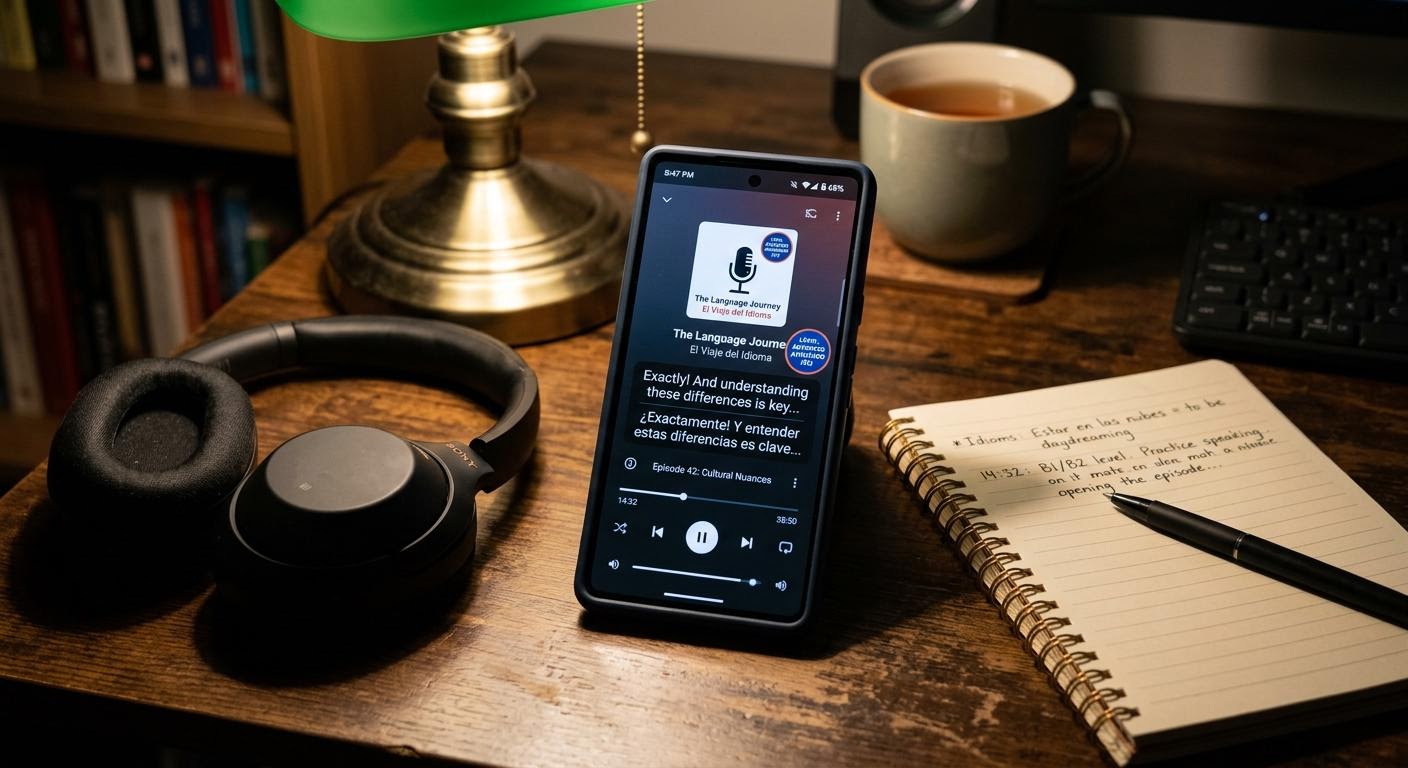
The listening experience compared
Beyond learner types, four practical dimensions separate these apps.
Content depth. EWA and RedKiwi offer curated clips, which are engaging but short. Snipd covers podcasts without any learning layer. ListenLeap keeps the full, unscripted episodes that learners eventually have to face in the real world, from BBC news to TED talks, organized into 20+ topic areas and searchable by difficulty.
Subtitles and support. RedKiwi offers bilingual subtitles in 10+ languages, and EWA supports several languages as well. Snipd transcribes in one language without translation. ListenLeap pairs real podcasts with bilingual subtitles plus tap-to-look-up words, phrase-level analysis and full-sentence explanations, so a difficult episode never stalls a learner completely.
Speaking feedback. EWA's dubbing gives basic scores, and RedKiwi offers shadowing without AI grading. Snipd has no speaking features at all. ListenLeap scores shadowing across pronunciation, intonation and fluency, which turns repetition into measurable improvement instead of guesswork.
Offline and devices. EWA and RedKiwi support downloads, and Snipd needs a connection for AI features. ListenLeap caches episodes fully offline and exports study notes to PDF, which suits commuters with patchy signals. It also runs on iOS, Android and Web, while the other three are mobile only.
Why ListenLeap works as a complete listening studio
None of the other three apps is weak at what it does. EWA owns the all-in-one beginner space, RedKiwi owns gamified video practice, and Snipd owns podcast knowledge management. What ListenLeap adds is depth inside the listening process itself.
Take one episode of a TED talk. A learner starts with blind listening, trying to catch meaning without subtitles. Then bilingual subtitles reveal what was missed. Tapping a word shows its meaning instantly, and phrase analysis explains why a group of words behaves the way it does. Smart summaries condense the episode for review. Shadowing practice with three-axis scoring in pronunciation, intonation and fluency works on output. Fill-in training tests recall. Every new word lands in a vocabulary notebook with the original audio attached, and everything can be exported to PDF for offline study.
That sequence is the reason the app pairs real, unscripted content with a full learning system. Curated clips are pleasant, but they do not prepare a learner for a live BBC interview. ListenLeap's i+1 leveling keeps material challenging without becoming crushing, which is the difference between consistent progress and quiet quitting.
Which one should you pick in 2026?
Pick EWA if starting from zero and wanting one app that covers vocabulary, reading, grammar and conversation in a single place.
Pick RedKiwi if short videos hold attention better than anything else and gamified streaks make practice stick.
Pick Snipd if podcasts are a knowledge source first and the priority is capturing ideas, not language mechanics.
Pick ListenLeap if the goal is to understand real podcasts at full speed, with leveling, bilingual subtitles, blind listening and scored shadowing all in one workflow.

Start listening today
All four apps are free to try, so the fastest way to decide is a week with each. For learners serious about real podcast listening, ListenLeap is the one that turns 10,000+ episodes into a structured training system rather than a passive feed. Download it on iOS, Android or Web, take the level test, and let the first episode be the start.


Comments
No comments yet.
Leave a Comment