
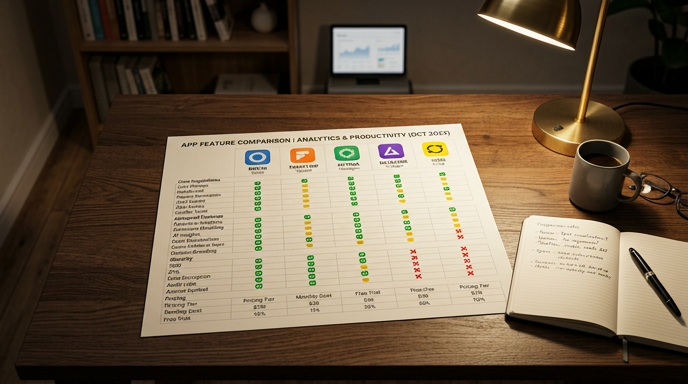
The Gap Between Features and Real Learning
Every language app on the market lists features. Bilingual subtitles. AI scoring. Smart summaries. Offline mode. But a feature list tells you what an app can do, not how well it does it — or whether the feature genuinely helps you learn.
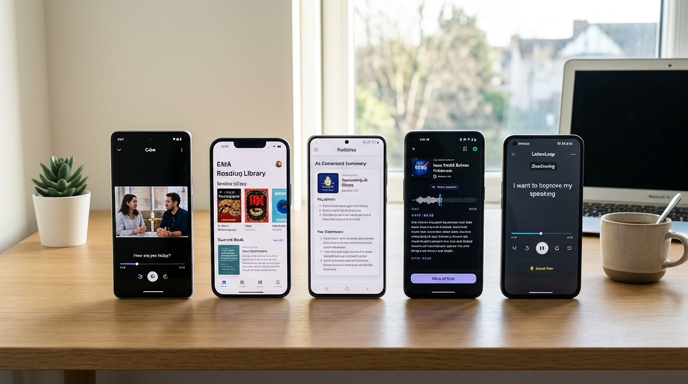
Cake, EWA, PodWise, and Snipd each approach English learning from a different angle. Their features reflect their priorities. But when you look beyond the surface, the actual learning value varies significantly. This breakdown examines what each app genuinely delivers across five critical dimensions — content depth, AI automation, active output tools, learning path design, and ecosystem completeness — and where ListenLeap brings capabilities that none of these four fully offer.
Content Depth: From Bite-Sized Snacks to Immersive Meals
Cake has mastered the art of the micro-lesson. Its library of over 100,000 video clips — drawn from YouTube, movies, and TV shows — is one of the largest in the language learning space. Content updates daily, ensuring learners always have something fresh. The clips are curated for learning value, not just entertainment, and each one comes with bilingual subtitles and interactive vocabulary cards.
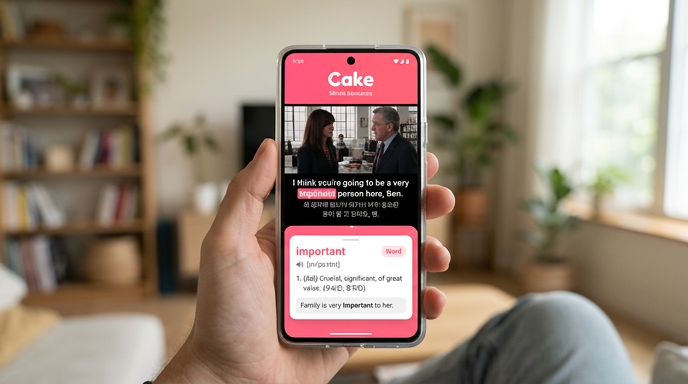
What this means for learning: Cake excels at building familiarity with natural English through short, repeatable exposures. The clips are long enough to teach a phrase or grammar pattern, short enough to watch between meetings. For learners who can spare five minutes a day, Cake's content model is highly effective — as long as the goal is exposure rather than mastery. The limitation is depth. Cake clips introduce but do not reinforce. Learners who need to understand a concept deeply will outgrow the format.
EWA takes a radically different content approach. Instead of video clips alone, EWA offers a graded reading library with over 1,000 books, movie and TV clips for dubbing practice, audio courses, and structured grammar lessons. This breadth is genuinely unmatched among these five apps — no other competitor offers video, reading, audio, and grammar under one subscription.
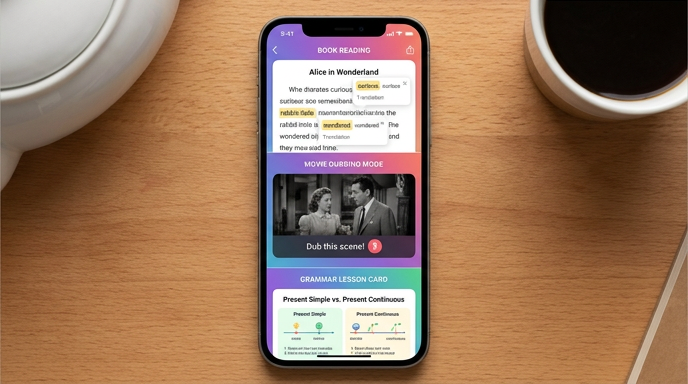
The learning impact is real for learners who crave variety. Reading books builds vocabulary depth that video clips alone cannot match. Dubbing clips builds speaking confidence. Grammar lessons fill structural gaps. However, the depth varies by module. The reading library is substantial, but the AI chatbot is basic, and the dubbing feature lacks granular pronunciation feedback. EWA's content breadth is its strength and its weakness — it covers more ground than any competitor, but no single module reaches specialist depth.
PodWise and Snipd do not maintain content libraries at all. Both integrate with users' existing podcast subscriptions, using AI to add a learning layer. PodWise generates summaries, chapter breakdowns, and flashcards from any podcast episode. Snipd focuses on capturing key insights through its signature "snip" feature, transcribing and summarizing highlighted segments with export to knowledge management tools.
For learning purposes, the no-library approach is a philosophical choice. It respects that advanced learners already have content preferences and simply need better tools to extract value. But it places the entire content discovery burden on the user — a barrier that beginners and intermediate learners may struggle with. Without a library, there is no algorithm suggesting "what to learn next" based on difficulty or interest.
ListenLeap bridges both approaches. Its curated library of 10,000+ podcasts from BBC, TED, NPR, and premium sources across 20+ categories provides the discovery layer that PodWise and Snipd lack. The import feature adds the flexibility that self-directed learners value. Every piece of content — curated or imported — is processed through the same AI pipeline: i+1 difficulty grading, bilingual subtitles in four languages, and interactive learning tools.
AI Automation: From Helpful Assistant to Core Learning Engine
Cake uses AI primarily for pronunciation scoring in its speaking exercises. The AI compares user recordings to native models and provides a score. It works well enough to guide improvement, but the feedback is one-dimensional — a single score without breakdown of what specifically needs work.
EWA integrates an AI chatbot for conversational practice. Users can type or speak responses and receive automated replies. The chatbot adds variety but lacks the depth of dedicated conversation AI tools. It is better suited for casual practice than serious skill building.
PodWise is where AI automation reaches its fullest expression among these four. The app automatically generates summaries, chapter breakdowns, and flashcards from any podcast episode — with no user effort beyond selecting the episode. The AI quality is impressive, with accurate transcription and useful summarization that genuinely saves time.
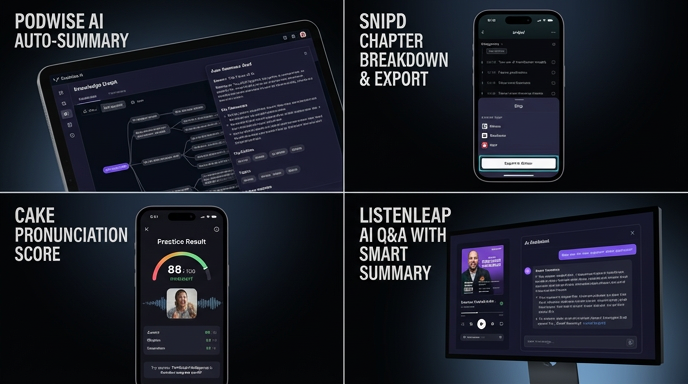
Snipd uses AI for its core snip feature — automatically transcribing and summarizing highlighted podcast segments. The AI chapter splitting is among the best in the podcast space, with accurate segmentation and useful summaries. The integration with knowledge management tools (Notion, Readwise, Obsidian) adds practical value for users who want to save insights for later reference.
ListenLeap integrates AI across multiple learning dimensions rather than a single feature. The i+1 difficulty grading system starts with a level test and dynamically adjusts content recommendations — an adaptive layer that no competitor here offers at the same granularity. The AI Q&A feature lets learners ask follow-up questions about any word or phrase, providing contextual explanations beyond dictionary definitions. Smart summaries distill each podcast into key takeaways, golden sentences, and useful expressions. The AI is not a single feature — it permeates the entire experience.
Active Output Tools: Where Listening Becomes Speaking
This dimension reveals the biggest gap among these five apps. Cake offers AI-driven pronunciation scoring, making it the only app among the four video-focused competitors that attempts to address speaking. The feature is useful but limited to a single score without dimension-level feedback.
EWA includes a movie dubbing mode where users voice over clips and receive scores. The feature is entertaining and builds speaking confidence, but the feedback lacks the granularity needed for real pronunciation improvement.
PodWise and Snipd offer no speaking or pronunciation features whatsoever. Both are designed exclusively for comprehension and knowledge management. Users who need speaking practice must look elsewhere.
ListenLeap offers the most comprehensive speaking toolkit of the five. Its shadow speaking mode evaluates learners across three separate dimensions: pronunciation accuracy, intonation naturalness, and fluency. This multi-axis scoring provides actionable feedback — learners know whether their intonation is off even when pronunciation is correct, or whether they are speaking fluently but with accented sounds. Combined with fill-in-the-blank exercises that reinforce vocabulary from speaking practice, ListenLeap creates a genuine listening-to-speaking loop that no competitor in this group matches.
Learning Path Design: Structure Without Rigidity
Cake organizes content into themed courses and grammar-focused lessons, adding structure to its clip library. Users can follow a path without feeling trapped in a rigid curriculum. The daily content refresh keeps learners coming back, and the streak system builds habit. The path is light enough to be flexible but clear enough to provide direction.
EWA offers personalized learning plans based on a level test, with content recommendations across its multimodal ecosystem. The path is adaptive in theory but limited in practice — recommendations are broad rather than granular.
PodWise and Snipd offer no learning paths whatsoever. They are tools, not courses. Users decide what to listen to, what to learn, and what to skip. This works for self-directed learners but leaves less motivated users without guidance.
ListenLeap combines structured and flexible learning. The i+1 difficulty grading system provides a clear progression path from beginner content to advanced podcasts. The level test establishes a starting point, and the algorithm adjusts recommendations as the learner improves. Users can follow the recommended path or branch out independently. The combination of adaptive structure plus free exploration is rare — most apps commit to one approach or the other.
Ecosystem Completeness: Where Can You Actually Use It?
Cake runs on iOS, Android, and web (cake.day) — strong cross-platform coverage. Offline access requires premium subscription and pre-downloading content.
EWA is mobile-only (iOS and Android) with no web version. Offline mode is available for downloaded lessons through premium.
PodWise and Snipd are mobile-only with iOS and Android apps. Snipd supports cloud syncing across devices. AI features require internet connectivity.
ListenLeap covers iOS, Android, and web — matching Cake's platform breadth while adding offline caching for podcast downloads and study without internet. The PDF export feature allows screen-free study through printed transcripts. The sleep timer adds a practical touch for learners who study before bed. For commuters, travelers, and users with limited data plans, these offline capabilities make a meaningful difference in consistency.
The App That Covers the Most Ground
Each of these five apps delivers genuine value in specific areas. Cake offers the most polished micro-learning experience with daily fresh content. EWA provides the widest content variety spanning video, reading, audio, and grammar. PodWise leads in AI-powered podcast automation — turning passive listening into structured study with minimal effort. Snipd excels at deep podcast knowledge capture with best-in-class export to personal knowledge management tools.
But none of these four covers the full learning cycle alone. Learners who want curated content, AI personalization, deep speaking analysis, flexible import, adaptive difficulty, and cross-platform offline access end up juggling multiple tools — or finding a single app that brings it all together.
ListenLeap is that single app for an increasing number of learners. Its podcast-first architecture provides the content depth that PodWise and Snipd users appreciate. Its AI i+1 difficulty system delivers personalization that Cake and EWA hint at but do not fully execute. Its three-dimension shadow speaking scoring fills the output gap that every competitor in this comparison leaves open. For learners who have grown tired of app-hopping, integration is not a luxury — it is the point.


Comments
No comments yet.
Leave a Comment