

Understanding a language isn’t just about vocabulary—it’s about being able to follow real people at real speed. If you can listen well, everything else improves: speaking feels easier, pronunciation gets cleaner, and conversations stop feeling like a blur.
Below is a simple, repeatable way to build stronger listening skills without spending hours a day or relying on perfect subtitles.
What “listening” really means in language learning
Listening isn’t passive. Good listeners are constantly doing three things at once:
Catching sounds (even when words blend together)
Predicting meaning from context (topic, situation, common phrases)
Recovering fast when they miss something (without panicking)
That’s why “I know the words, but I can’t understand people” is so common—you learned words, but you didn’t train your brain to handle speech.
Why most people get stuck
A lot of learners practice in ways that feel productive but don’t match real life:
Audio is too hard too soon → you understand nothing, so you quit
Audio is too easy for too long → you feel comfortable, but progress stalls
Only one accent/speaker → you freeze when a new voice appears
You never check what you misheard → mistakes repeat forever
You listen “once” and move on → your brain never gets a second chance to map sounds to meaning
The fix is not “more listening.” It’s better-structured listening.
How to listen better: a step-by-step guide (7 steps)
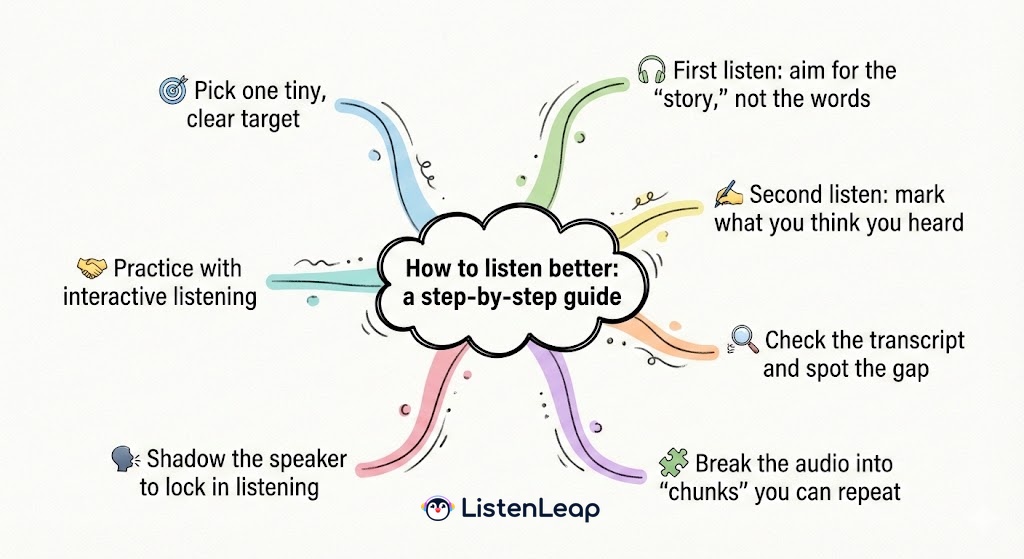
🎯 Pick one tiny, clear target
Choose one short audio clip (30–90 seconds). It should match your level: you can catch some words, but not all.
Good sources: short interviews, simple news clips, graded dialogues, everyday conversations.
🎧 First listen: aim for the “story,” not the words
Listen once without pausing. Ask:
Who is speaking?
Where are they?
What’s happening?
What’s the mood?
This trains you to use context—exactly what real conversations require.
✍️ Second listen: mark what you think you heard
Play again and write:
keywords you recognize
phrases you’re unsure about
spots where everything becomes noise
Don’t worry about spelling. The goal is to capture sound.
🔎 Check the transcript (or generate one) and spot the gap
Now compare what you wrote vs. what was actually said.
Look for patterns like:
missing endings (“gonna,” “wanna,” dropped consonants)
linking (“next_day,” “want_it”)
common reductions (“did you” → “didja”)
This is where improvement comes from.
🧩 Break the audio into “chunks” you can repeat
Split the clip into 3–6 bite-sized parts. Loop each part until you can hear it clearly.
A quick rule:
If you can’t repeat it, you can’t really hear it yet.
🗣️ Shadow the speaker to lock in listening
Shadowing = speak along with the audio (quietly is fine).
This forces your brain to match:
rhythm
stress
connected speech
It’s one of the fastest ways to make spoken language sound “clearer” over time.
🎙️ Practice with podcast-based interactive listening
At some point, you need listening practice built around real, natural speech—like the kind you hear in podcasts—combined with tools that help you actively engage instead of passively consume.
A quick table to keep your practice balanced
Tips, advice, and common mistakes
Tips
Stay short and repeat often. Ten minutes with repetition beats an hour of random audio.
Rotate voices. Use at least 3 different speakers per week.
Use “easy + hard.” Mix one comfortable clip with one challenging clip to avoid stagnation.
Common mistakes
Relying on subtitles forever. Try: no subtitles first, subtitles last.
Practicing only formal speech. Real conversations are messy—train for that.
Skipping the “check” step. If you never verify, you never correct.
A practical weekly rhythm
4 days: short clips + looping + shadowing
2 days: structured podcast-based practice (e.g., guided listening inside an app)
1 day: light listening for fun (music/podcasts)
FAQ
How long does it take to noticeably improve listening? With consistent practice (10–20 minutes/day), many learners notice clearer comprehension in 2–4 weeks, especially if they repeat short clips and check transcripts.
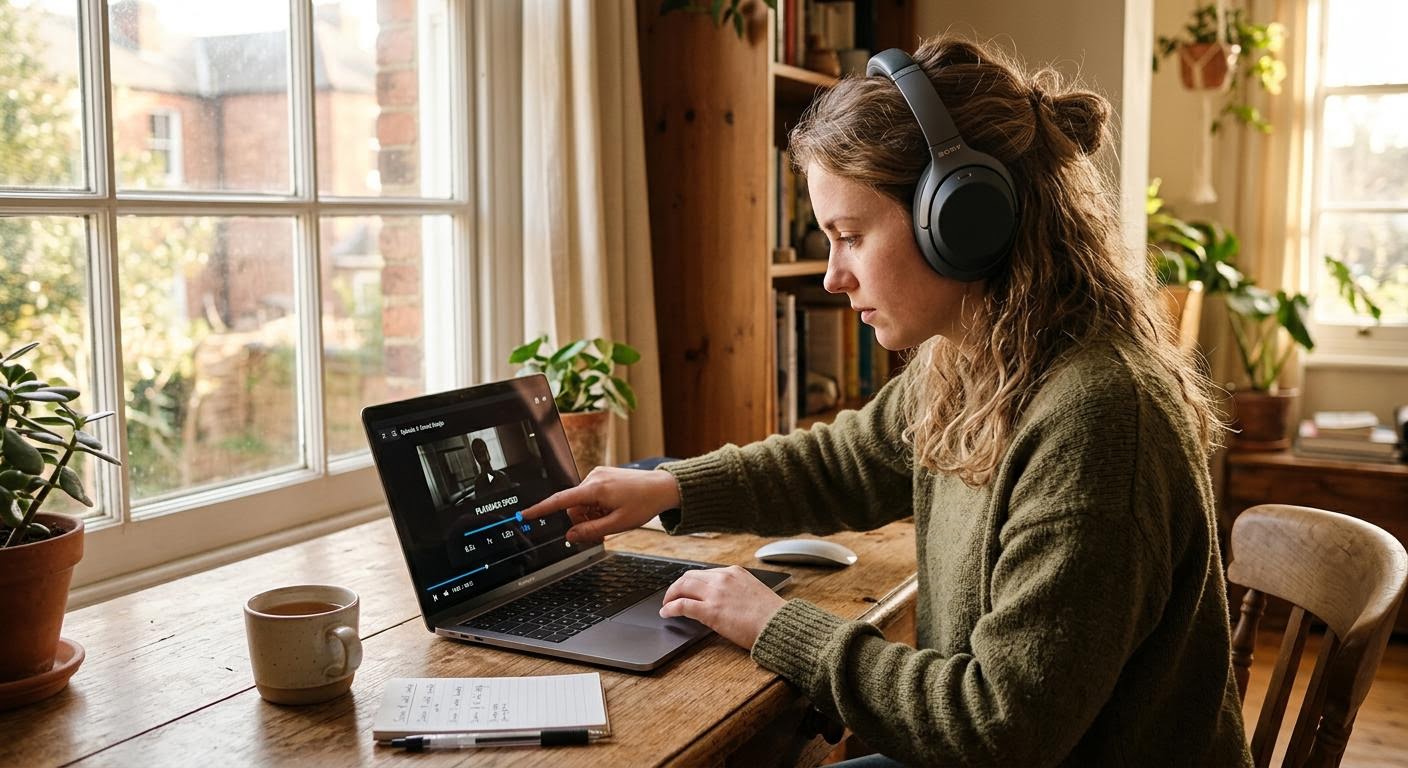
Should I slow down audio? Yes—briefly. Slow it down to identify sounds, then return to normal speed quickly. Staying slowed down too long can become a crutch.
Is it normal to understand less in real life than in lessons? Completely normal. Real speech has background noise, interruptions, and casual phrasing. Training with authentic podcast and video content helps bridge that gap.
What if I don’t have anyone to practice with? Use structured tools built around real spoken English. ListenLeap is designed for this: it recommends podcast content suited to your level and supports you with AI-powered guidance so you can actively practice listening anytime.
Do I need to understand every word? No. Aim for meaning first. Even native speakers miss words—they just recover quickly using context.
Key takeaways + your next step
Listening improves fastest when you repeat short audio, verify what you misheard, and train with real conversational speed.
Don’t chase perfect comprehension—train context + recovery.
Add structured, podcast-based listening to make your skills usable in real situations.
If you want a simple way to practice realistic listening every day, download ListenLeap. Go to the App Store or Google Play, search “ListenLeap”, and start with a podcast episode matched to your level today.
Comments
No comments yet.
Leave a Comment