
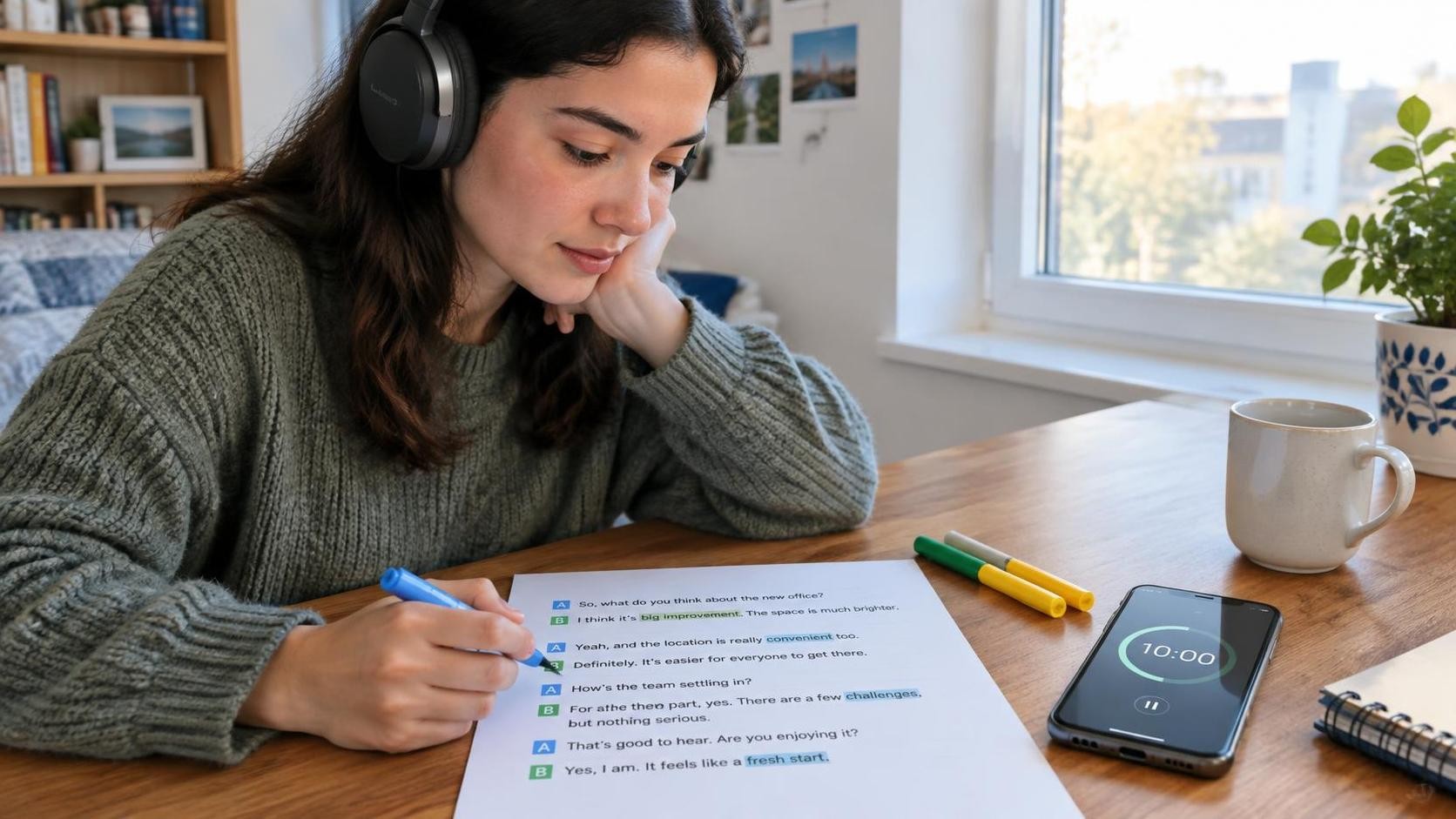
Level: B1. Goal: shadow a two-speaker podcast dialogue for ten minutes and stop losing the thread when the voices change.
The short answer is to assign roles before playing the audio. A learner should not try to shadow two voices at the same time from the first minute. Pick one host as the anchor, mark every turn in the transcript, shadow the anchor alone, then the second voice, then the full exchange. A 90-second block is enough. This guide uses one verified BBC 6 Minute English episode, gives exact timings for a ten-minute drill, lists three turn-taking sounds to notice, and ends with a score sheet. It suits B1 learners who can follow a simple conversation with some gaps and who want to practise dialogue, not a monologue.
The episode and the exact segment
| Item | Detail |
|---|---|
| Show | 6 Minute English, BBC Learning English |
| Episode | What should you eat for a better night's sleep? |
| Published | 22 October 2026 |
| Length | 7 minutes 3 seconds |
| Voices | Two hosts, Georgie and Phil, in a studio conversation |
| Accent and pace | British English, normal broadcast pace, with connected speech and no learner slowdown |
| Transcript | A free transcript and quiz are offered at bbclearningenglish.com; the feed notes temporary technical issues, so download the transcript before the session |
| Audio | Free in the 6 Minute English podcast feed and on BBC Sounds |
| Segment | 0:00 to 1:30, the opening setup and the episode question about sleep |
The first 90 seconds are the right place to start because the roles are clear. One host sets the scene, the other reacts, and the question arrives early. The segment is short enough to repeat, and the two voices are different enough to tell apart.
This is a worked example, not a classroom trial. The title, date, length and hosts come from the public podcast feed. The 1:30 boundary is a recommendation, not a marker in the audio. Stop at the first clear pause after the question.
Why two voices break a shadowing session
A monologue gives the learner one rhythm to copy. A dialogue gives two, and the switch costs a beat. The second voice often starts before the first has finished, a short backchannel lands in the middle of a sentence, and the quieter speaker may be the faster one.
At B1, the result is predictable. The learner follows the host who asks the questions, then loses the answer. Or the learner shadows the answer and misses the next question. The problem is not vocabulary. It is turn management.
Most shadowing advice ignores this because it assumes one speaker. The fix is simple: treat the dialogue as two separate parts, practise each part, then join them. That is the whole method.
The ten-minute turn-taking drill
Set a timer. Keep the transcript closed for the first pass. The order matters more than the total time.
Minutes 0 to 2: blind listen for turns
Play the 90 seconds once without stopping and without text. Do not pause. Count the turns instead of translating. A turn is one speaker holding the floor until the other takes over.
At the end, answer three questions: who speaks first, who asks the question, and who gives the short reactions. A learner who cannot answer any of these should use a shorter block or a lower level. Turn counting is easier than full comprehension, so it gives an early win.
Minutes 2 to 4: mark the transcript
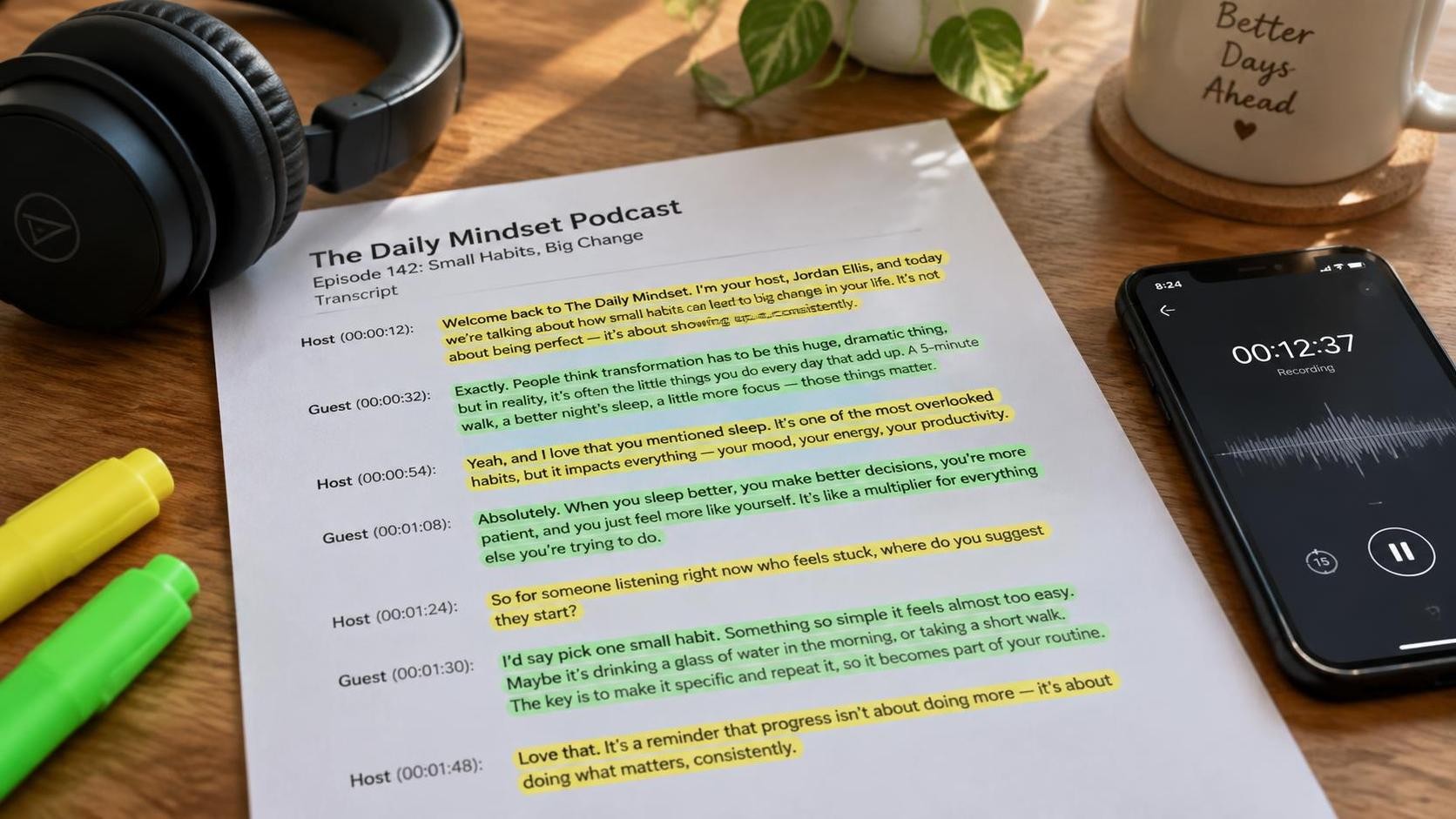
Open the transcript and label the speakers A and B. Use two colors if possible. Then mark four things:
- every change of speaker with a vertical line
- short reactions such as yeah, right, mmm and exactly
- places where the second voice starts before the first stops
- the three longest runs by one speaker
Do not translate the whole transcript. Do not make a list of twenty words. The markings are a map for the ear.
Read the marked lines aloud once, slowly. This is a check that the mouth can produce the words, not shadowing yet.
Minutes 4 to 6: shadow speaker A only
Play only the anchor's turns. Pause whenever the other voice starts, then jump to the next anchor turn. Repeat each turn immediately, matching the melody rather than the volume.
The anchor is usually the host who introduces the topic and asks the question. That voice carries the structure, so it is the safest place to start.
Minutes 6 to 8: shadow speaker B only
Now play only the second voice. This pass is harder because the turns are shorter and the reactions are fast. Keep the reactions short. Do not turn yeah into a full, clear word with a long vowel. The small size is the point.
If the second voice is much faster, slow the audio to 90 percent for this pass. Return to full speed for the next pass.
Minutes 8 to 9: shadow the whole exchange
Play the full 90 seconds and shadow both voices. Switch at each handoff. A small lag is normal; chasing every word causes a larger collapse. The target is to enter with the new voice within one beat.
If the full pass fails completely, return to one speaker for the remaining time. Do not add new material.
Minutes 9 to 10: retell the exchange
Close the transcript. Record a 60-second retell that keeps the two roles separate: what the first host asked, what the second host answered, and what question was left open. The retell does not need perfect grammar. It needs to be clear who said what.
Listen once. Note one handoff that was late and one reaction that was over-pronounced. Those notes become the warm-up for the next session.
Three things to notice in this segment
1. Falling pitch at the end of a turn
In a studio dialogue, a speaker usually lets the pitch fall at the end of a statement. That fall signals that the turn is finished. A rise can signal a question or an invitation for the other voice to react.
A learner who copies only the words, not the pitch, often sounds like a list. Listen for the last two or three syllables of each turn. Copy the direction of the voice, not just the sounds.
2. Backchannels are smaller than they look
Short reactions such as yeah, right and mmm are not pronounced with full strength. The vowel in yeah can shrink toward a schwa, and the final consonant can soften. These words are fast because they carry little information.
Practice them at low volume and short length. A learner who says yeah with a full, long vowel will sound louder and slower than the host, and the handoff will feel wrong even when the words are correct.
3. The handoff is not a pause
Two speakers in a conversation often overlap by a syllable or two. The next voice starts before the previous one has fully stopped. This is normal, not a recording error.
Practice entering early. Play the last three words of a turn and start the next voice on the final word. The first attempts will feel rude. That feeling is a sign that the timing is closer to real speech.
The episode also offers useful chunks: struggle with sleep, get to sleep and sleep quality. Store them as whole phrases, not single words. A chunk arrives ready to speak.
Self-assessment table
Score each row after the retell. A score of 2 means the skill held without the transcript.
| Check | 0 points | 1 point | 2 points |
|---|---|---|---|
| Turn map | No clear count | Most turns counted | Every turn counted and labelled |
| Anchor pass | Words repeated after long pauses | Most anchor turns followed | All anchor turns followed at host speed |
| Second voice | Reactions missed | Some reactions caught | Short reactions matched in length |
| Handoff | Constant stopping | Entered after a full pause | Entered within one beat |
| Retell | Voices mixed together | Roles mostly clear | Roles, question and detail clear in 60 seconds |
Total score: 0 to 3 means repeat the same block tomorrow. 4 to 6 means repeat once, then take the next 90 seconds. 7 to 10 means the block is ready for a three-speaker show or a longer segment.
A seven-day progression
Day one runs the full drill. Day two swaps the anchor: shadow the second voice first. Day three adds the next 90 seconds of the episode. Day four repeats both blocks without the transcript for the first listen. Day five records a two-role retell that covers both blocks. Day six listens to the full episode for pleasure, without marking anything. Day seven tests the first block at full speed and decides whether to keep the episode or move on.
The swap on day two matters. Most learners have a favourite voice, and the weaker role stays weak without a dedicated pass.
When to add a third voice
A learner is ready for a panel show when three signs appear: the 90-second handoff feels late rather than fast, the retell keeps the roles clear without notes, and the short reactions appear in speech without planning. At that point, the same drill works with three labels, A, B and C, and a 90-second block.
A panel show is not the first step. Three voices without a map turn into noise.
Where ListenLeap fits
ListenLeap (listenleap.com) is an app for learning English with podcasts and videos. It suits learners who already have a specific episode and want to keep the audio, the transcript and repeated listening in one place. It does not replace the passes above, and it is not the right starting point for a learner who still needs a graded course with controlled vocabulary. The method works with any player that can pause and replay a short segment. The app is a convenience, not a shortcut.


Comments
No comments yet.
Leave a Comment