
.jpg)
Even confident English learners make subject-verb agreement errors. The problem usually isn’t a lack of vocabulary or ideas. It’s the small grammar details that slip by when you’re speaking or writing quickly. These errors can make your message sound unnatural or confusing, especially in professional or academic situations.
If you want your English to sound clear and natural, mastering subject-verb agreement is one of the fastest ways to improve.
What subject-verb agreement actually means
Subject-verb agreement simply means that the verb must match the subject in number.
Singular subject → singular verb
Plural subject → plural verb
Examples:
This seems simple, but the structure of real sentences often hides the true subject.
Where most learners go wrong
Common situations that cause mistakes include:
Long sentences The list of items are on the desk. ❌ The real subject is list (singular), not items.
Indefinite pronouns Everyone, someone, nobody → always singular Everyone have finished. ❌ Everyone has finished. ✔
Compound subjects Tom and Jerry are friends. ✔ But: Peanut butter and jelly is my favorite snack. ✔ (seen as one idea)
Collective nouns Team, family, group → usually singular The team are winning. (common mistake)
How to fix subject-verb agreement step by step
1️⃣ Identify the real subject Ignore extra phrases between the subject and verb. The box of chocolates is on the table. The subject is box, not chocolates.
2️⃣ Decide if the subject is singular or plural Ask yourself:
One person/thing → singular
More than one → plural
3️⃣ Match the verb form In present simple:
Example: She works late. They work late.
4️⃣ Watch for tricky pronouns Always treat these as singular:
Everyone
Someone
Each
Nobody
Anybody
Example: Each student has a book.
5️⃣ Practice with real conversations Practice with real conversations instead of isolated exercises. Engaging in authentic dialogue forces you to apply grammar naturally, adapt to spontaneous responses, notice mistakes, and internalize correct structures through meaningful, repeated use.
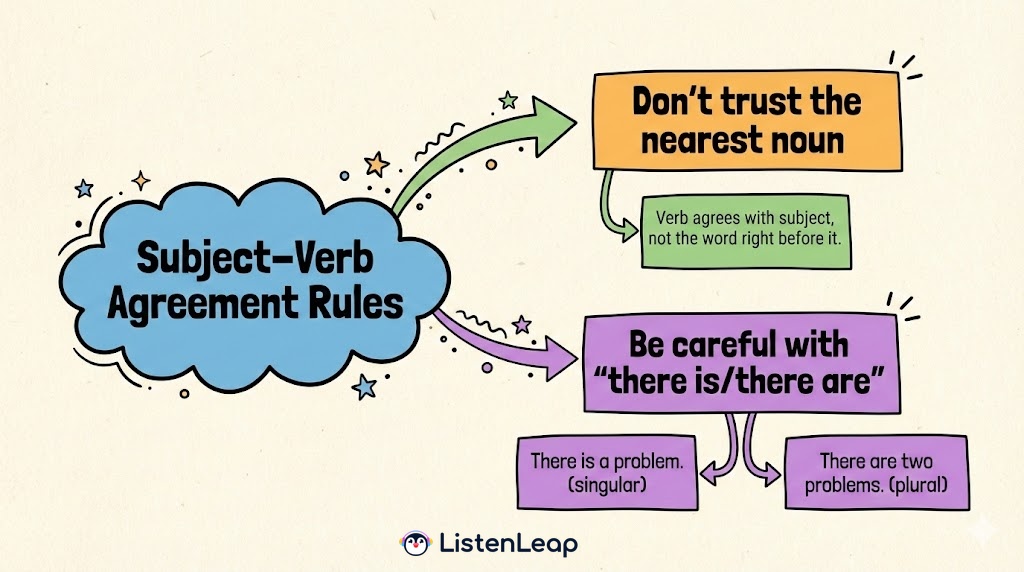
Quick visual summary of key rules
Tips, advice, and common traps
Don’t trust the nearest noun The verb agrees with the subject, not the word right before it.
Be careful with “there is/there are” The verb matches the noun after it.
There is a problem.
There are two problems.
Slow down when speaking Many agreement errors happen because of speed, not knowledge.
Practice out loud Practice out loud consistently to reinforce pronunciation, rhythm, and grammatical patterns. Actively engaging your voice strengthens neural pathways. Tools like ListenLeap’s shadowing exercises can accelerate fluency by training real-time listening and speaking coordination.
FAQ
Why is subject-verb agreement important? It makes sentences clear and natural. Incorrect agreement can confuse listeners or make writing sound unpolished.
Is this only a problem for beginners? No. Even advanced learners make these mistakes in fast speech or complex sentences.
How long does it take to fix this problem? With regular speaking practice and feedback, many learners see improvement in a few weeks.
What’s the best way to practice? Combine brief, focused grammar reviews with daily conversational practice to reinforce rules in context, improve retention, build fluency naturally, and immediately apply newly learned structures in real-life speaking situations.
Key takeaways
The verb must match the subject, not nearby nouns.
Indefinite pronouns are usually singular.
Long or complex sentences hide the real subject.
Consistent speaking practice helps fix agreement errors faster.
If you want to sound more natural and confident in English conversations, start practicing regularly. Download ListenLeap AI from the App Store or Google Play, and practice real-life speaking scenarios with an adaptive AI tutor today.




Comments
No comments yet.
Leave a Comment