

5 Best Business English Podcasts to Sound Smarter at Work in 2026
There's a gap between "I can speak English" and "I can hold my own in a boardroom." Grammar courses won't close it. The missing piece is exposure — hearing how senior executives frame arguments, how consultants present data, how founders pitch under pressure. That kind of language doesn't live in textbooks. It lives in business podcasts.
The five shows below aren't language-learning podcasts disguised as business content. They're genuine business podcasts consumed by millions of native speakers — which is exactly why they work. You absorb real vocabulary in real context, the way it's actually used in conference rooms from Singapore to San Francisco.

Why Business Podcasts Hit Different on ListenLeap
Listening to a McKinsey consultant explain market dynamics is one thing. Understanding every term they use is another. ListenLeap bridges that gap in ways a regular podcast app cannot.
Tap any word, get everything.When the host drops "synergies" or "unit economics" or "total addressable market," one tap gives you the definition, pronunciation (both British and American), common collocations, and example sentences — without leaving the player.Bilingual subtitles running in real time.See the English transcript alongside a translation in Simplified Chinese, Traditional Chinese, Japanese, or Korean. For business jargon that doesn't translate literally, this side-by-side view is invaluable.AI episode summary before you press play.ListenLeap generates a quick overview — key points, notable quotes, and useful business expressions — so you can pre-load context. Walking into a 30-minute McKinsey episode already knowing the topic cuts cognitive load in half.Shadow reading with triple scoring.Pronunciation, intonation, and fluency — scored separately. Practice repeating a CEO's pitch delivery until your rhythm matches theirs.
The Five Picks
1. Masters of Scale
Host:Reid Hoffman (LinkedIn co-founder) |Length:30–45 min |Update:Weekly
Reid Hoffman sits across from the people who built Airbnb, Stripe, Netflix, and Spotify — and asks them exactly how they did it. Each episode follows a single thesis ("The best way to scale is to do things that don't scale") and pressure-tests it through real founder stories.
What your English gains:Executive-level vocabulary — terms like "product-market fit," "blitzscaling," "network effects" — delivered in context with real anecdotes. Hoffman speaks in structured arguments, which trains your ear to follow complex reasoning chains. Guests range from soft-spoken operators to high-energy storytellers, exposing you to multiple presentation styles.On ListenLeap:The phrase parsing feature breaks down Hoffman's compound business metaphors into components. When a guest uses Silicon Valley shorthand you've never heard, one tap decodes it instantly. The AI summary highlights each episode's core thesis and key vocabulary before you listen.
2. How I Built This with Guy Raz
Host:Guy Raz (NPR) |Length:40–55 min |Update:Weekly
Guy Raz interviews the founders behind brands everyone knows — Spanx, Dyson, Patagonia, Instagram — and traces their journey from zero to household name. The format is chronological storytelling: failure, pivot, breakthrough, scale.
What your English gains:Narrative business English — how to tell a professional story with stakes, tension, and resolution. Founders speak candidly about "running out of runway," "pivoting the business model," and "finding distribution channels." The conversational interview style also teaches you natural transitions ("So at that point, what did you do?") that work in any business meeting.On ListenLeap:Episodes are long, but ListenLeap's segment looping lets you isolate the five-minute section where a founder explains their breakthrough moment and replay it until every word lands. The fill-in-the-blank mode is perfect for testing whether you caught key business phrases buried in fast conversation.

3. Harvard Business Review
Source:HBR |Length:20–30 min |Update:Weekly
The Harvard Business Review podcast brings the magazine's rigorous thinking to audio. Episodes cover management strategy, leadership frameworks, organizational behavior, and workplace dynamics — the same topics discussed in MBA classrooms, delivered by the researchers and executives who write for HBR.
What your English gains:Academic-professional register — the precise layer of English used in strategy documents, board presentations, and management consulting. You'll hear phrases like "competitive moat," "first-mover advantage," "organizational friction," and "stakeholder alignment" used naturally by people who coined them. The hosts ask structured follow-up questions that model how to probe ideas professionally.On ListenLeap:The vocabulary notebook feature lets you tag and collect business terms episode by episode, building a personal MBA glossary over time. The bilingual subtitles are especially useful here — HBR's management concepts often need careful translation to fully grasp.
4. Think Fast Talk Smart: Communication Techniques
Source:Stanford Graduate School of Business |Length:15–25 min |Update:Weekly
Matt Abrahams, a Stanford GSB lecturer, interviews communication experts on how to speak clearly under pressure — impromptu presentations, difficult conversations, persuasive pitching, virtual meetings. The focus is entirely practical: specific techniques you can use tomorrow.
What your English gains:Meta-communication skills in English — not just what to say, but how to structure it. Episodes teach frameworks like "What? So what? Now what?" for organizing spontaneous answers, or "Problem-Solution-Benefit" for pitching. You learn the English phrases that signal structure ("Let me frame this in three parts," "The key takeaway here is," "To put that in context"). These are the exact expressions that make non-native speakers sound polished in meetings.On ListenLeap:The shadow reading feature is tailor-made for this podcast. After learning a communication framework, you can practice delivering it with the same pacing and emphasis as the Stanford instructor. The triple scoring (pronunciation, intonation, fluency) tells you exactly where your delivery breaks down.
5. The McKinsey Podcast
Source:McKinsey & Company |Length:20–35 min |Update:Biweekly
McKinsey consultants and partners discuss industry trends, digital transformation, leadership, and global economics. The language is precise, data-driven, and structured — exactly the way top-tier consulting firms communicate with C-suite clients.
What your English gains:Consulting English — the most structured, logical, and persuasive form of business communication. McKinsey speakers use the "situation-complication-resolution" framework instinctively. You'll absorb phrases like "When we look at the data," "The implication for leaders is," and "Three factors are driving this shift" — the building blocks of executive communication in English.On ListenLeap:The AI summary extracts each episode's data points and key arguments, giving you a briefing before you listen. This mirrors how consultants actually prepare for meetings — pre-read the material, then engage with the discussion. The tap-to-look-up feature handles industry-specific terminology (think "digital twin," "ESG metrics," "supply chain resilience") without disrupting your flow.
How to Build a Routine
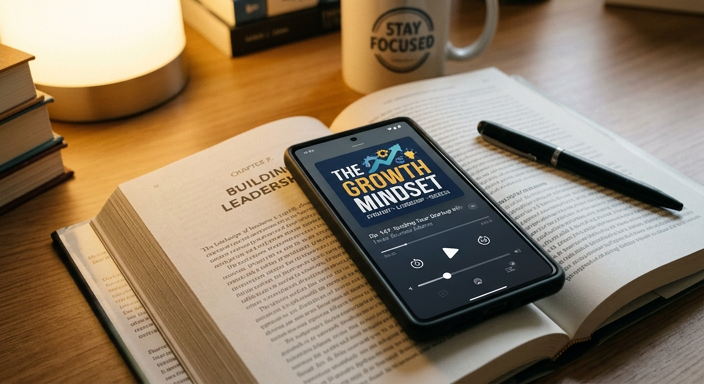
Daily (10 min):Listen to one Think Fast Talk Smart episode during your commute. It's short, tactical, and immediately applicable.Twice a week (30 min):Alternate between Masters of Scale and How I Built This. These are your storytelling and vocabulary expansion sessions.Weekly (25 min):Pick either HBR or McKinsey for your "deep work" listening session. Use ListenLeap's AI summary first, then listen with bilingual subtitles on. After the episode, review the five best phrases you caught and add them to your vocabulary notebook.Monthly review:Open your ListenLeap vocabulary notebook and test yourself on the business terms you've collected. The ones you can use in a sentence — keep. The ones that still feel foreign — relisten to the original episode segment.
The Compound Effect
None of these podcasts will make you fluent in business English overnight. But five months from now, after 100+ episodes absorbed through ListenLeap's bilingual subtitles, AI summaries, and shadow reading — you won't just understand business English. You'll sound like someone who belongs in the room. The vocabulary will come automatically. The frameworks will structure your thinking. The confidence will follow.
Pick one show. Press play. Let the compounding begin.




Comments
No comments yet.
Leave a Comment